
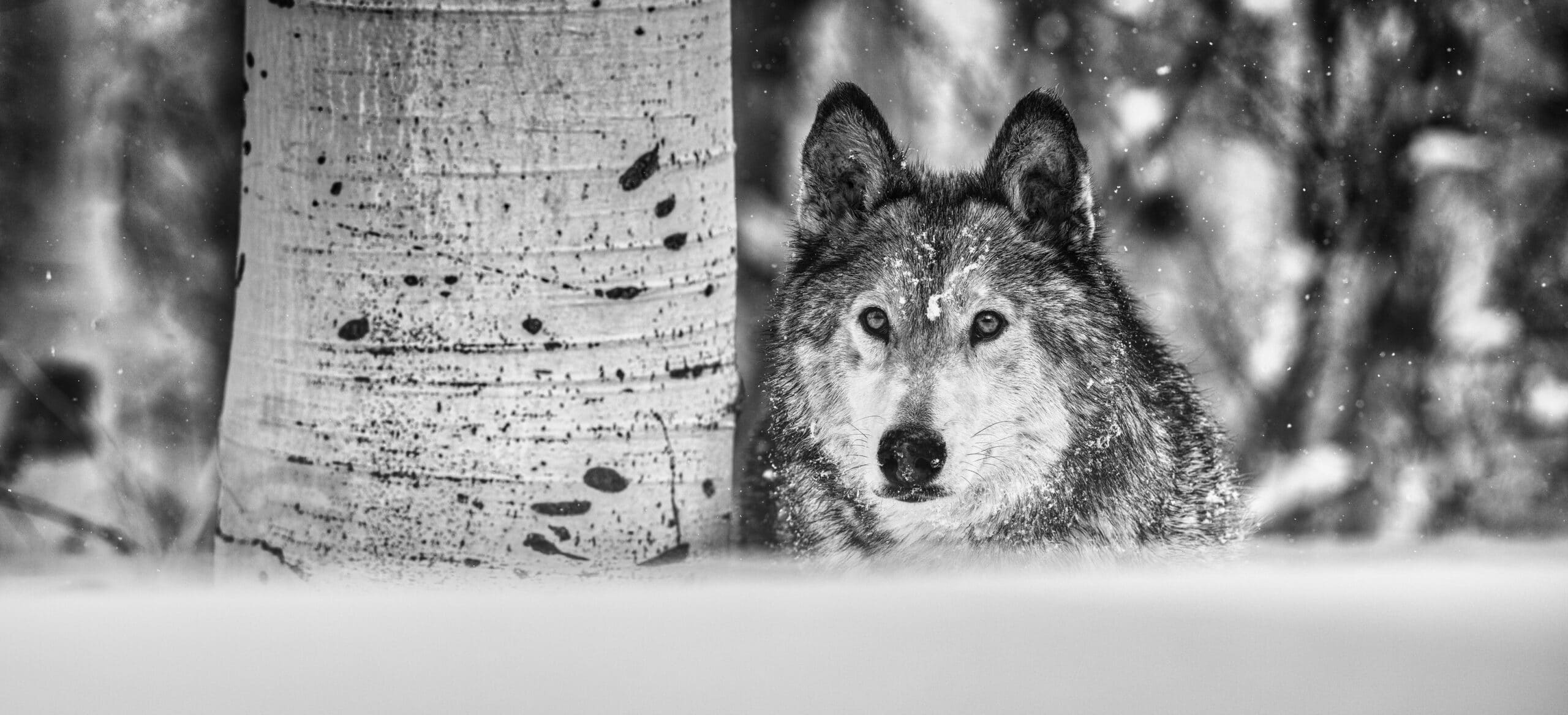
The Power of the Dog

The Rocky Mountains, 2022
This winter photograph is all the better for the cinematic crop. It gives context and allows me to capture as much falling snow as possible. A long and heavy snowfall was just coming to its end and I was knee deep at the time. A bit like the image Bearish from last summer of the mother bear in the rain, it is the snowfall that really lifts this portrait.
These are not easy images to get, and when the opportunity comes, the key part of the craft is to be acutely sensitive to the need for the eyes to be razor sharp. The most telling part of the photograph is the eyes and what they convey; as with humans, they are the window to the soul.
AVAILABLE SIZES:
LARGE: Edition of 12 + 3 AP
- Image Size: 47” x 103” in (119.38 cm x 261.62 cm)
- Framed Image: 62” x 118” in (157.48 cm x 299.72 cm)
STANDARD: Edition of 12 + 3 AP
- Image Size: 31” x 68” in (78.74 cm x 172.72 cm)
- Framed Image: 46” x 83” in (116.84 cm x 210.82 cm)
We ship worldwide and use a multitude of providers to safely deliver your masterpiece. Domestic delivery and installation may also be available via Hilton Asmus Contemporary’s private art shuttle. Please inquire.

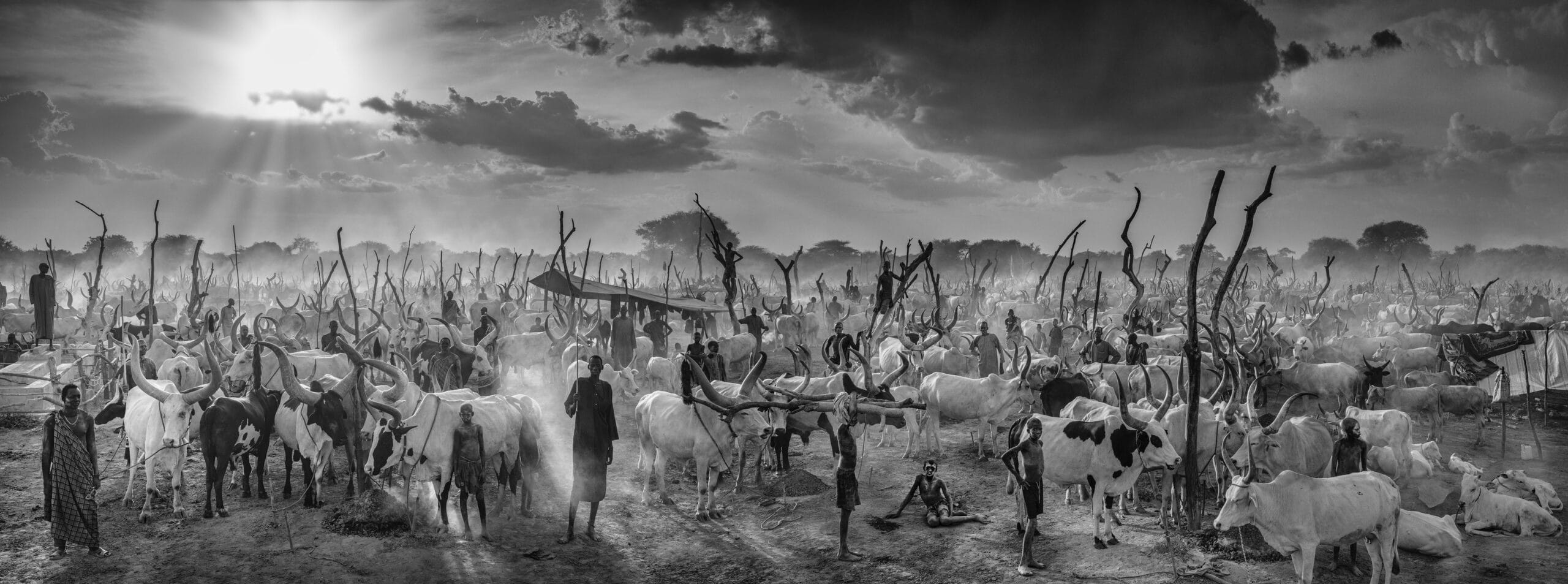
New Testament
South Sudan, 2022
In retrospect, my photograph Mankind, taken in South Sudan in 2014, was a stepping stone in my career. It was authentic, it had a biblical scale to it and could be looked at for a long time. Haunting and hellish one minute and serene and ethereal the next. Mankind elicited an emotional reaction despite how foreign the subject matter was.
The editions of the picture sold out quickly and the hammer price at Sotheby’s of $78,000 was then a record for my work. Since 2014, awareness of my art has grown materially, and I am sure this powerful image has played a role.
It was taken at a dangerous time in South Sudan’s short history and recently, during 2019 and 2020, the violence got worse. It simply was not safe for foreigners as many areas were loosely governed and guns were round every corner. It was sketchy at best and downright toxic at worst.
But since 2021, some calm has returned and tribal skirmishes in the cattle camps are now less common. I thought it was time to return. After all, I’d had eight years to think about what I could do differently. Cameras have certainly improved, and I have a further eight years of experience under my belt. I also had maintained contacts in South Sudan, in particular with those in charge of the large cattle camps to the south of Rumbek. This is no place to go without inside help, security protection and best in class field logistics. There must be a plan and there must be attention to detail.
But I knew it would be a mistake to go back and try to copy what I did eight years ago; it would hint at a lack of creative progression and courage. I needed to do better and offer a new story, to go backwards would be damaging at many levels. I had been preoccupied by that fear for some time and I knew that I had to be bold.
The Lakes areas of South Sudan are just about on a map, but way off the grid for most. It is the most basic of existences and the only material source of employment is the cattle camps. In 2014, I filmed near the town of Yirol in a camp on a Nile tributary, but this time I wanted to travel further into the interior and find an even bigger camp on the way to Rumbek. My premise was to play on scale and my leaning was always to go bigger not smaller. I am always greedy in the field. The Dinka tribe are the world’s tallest people, their cattle camps are the biggest of their kind and the cattle horns are Jurassic. This is a place to play on the word “big”.
My picture, Mankind, had novelty factor because it delivered such an emphatic sense of scale and place. Whilst I was nervous of treading old ground, familiarity is a friend not a foe, that’s why we often use the same talent in our storytelling. I needed to go one step further than I had in 2014, without losing any small individual stories within the image. My sense was that there needed to be even more of a visual overload in the frame and I found it difficult in my preconceptions to escape from the word “panoramic”. The local chiefs and the head of police knew where to take me and my security detail knew how to keep me safe. I would go into largely unchartered land where the Dinka had established a camp of over 10,000 cattle.
I have often thought that a photographer in the last eight years would go and try and take their own version of Mankind, but I haven’t seen any. Every week I see monochrome photographs of the big elephants of Kenya, many embracing a ground up approach and then the prints are framed in black wood with a white mount, edition number on left, signature on right. All come with a nice little narrative. Some of this work is excellent, but I think the market may be a little saturated. I am reminded of Warren Buffett’s wonderful prompt, “if you see a bandwagon, you have missed it”.
But no work is coming from South Sudan and I think I know why. The simple question is where on earth does a first-time visitor start on the logistics? With East African wildlife, all a photographer needs are a jeep, a guide and some nice camera gear and away they go. Sundowners in their $400 a night camp at 6.30pm and then 1000 photos to download. I am not sure Anthony Bourdain would have approved.
South Sudan is a very different gig and the discomfort of staying in a room costing $5 a night and eating a meal for $1 whilst security costs $2000 a day, is compensated by the comfort of knowing that there is a chance of authenticity. For an artist that is pure gold. I question whether anything is truly novel these days; all creation is influenced by what we have seen elsewhere, but this terrain is not well trodden.
I was excited to arrive in South Sudan and even more excited to leave when the job was done. In Kenya, my emotions are much more compressed because it is so mainstream and that is something with which I am increasingly uncomfortable. In my journey, I need to push on and accept challenges and this last week was certainly one.
There is about a 40-minute window for this kind of image; basically, the time between the cows returning to camp in late afternoon and half an hour before sunset. The hope, of course, is that there is direct sunlight. On a dull day with full cloud cover, the light can’t bounce off the smoke quite like it does here.
There was some maths involved in determining the best height for the ladder that travelled 500 miles with us; too low and there would not be enough depth and too high and we would lose immersion. I know not to fear long thin images, after all, The Bills is our most popular photograph of the last two years.
And so, to the name, The New Testament. It struck me that evening in the cradle of Mankind that the sensory overload in front of me was a metaphor. As our world spins ever faster, with kids addicted to celebrity culture and social media, students cancelling history and adults divided on so many issues, the world of the Dinka cattle camps has never really spun. There is continuity, simplicity and happiness. The scene I saw has been replicated for 2000 years. Most of us don’t know what world will exist for our children, but the Dinka do.
AVAILABLE SIZES: Available in Black & White and Monochrome
LARGE: Edition of 12 + 3 AP
- Image Size: 38” x 103” in (96.52 cm x 261.62 cm)
- Framed Image: 53” x 118” in (134.62 cm x 299.72)
STANDARD: Edition of 12 + 3 AP
- Image Size: 26” x 69” in (66.04 cm x 175.26 cm)
- Framed Image: 41” x 84” in (104.14 cm x 213.36 cm)
We ship worldwide and use a multitude of providers to safely deliver your masterpiece. Domestic delivery and installation may also be available via Hilton Asmus Contemporary’s private art shuttle. Please inquire.
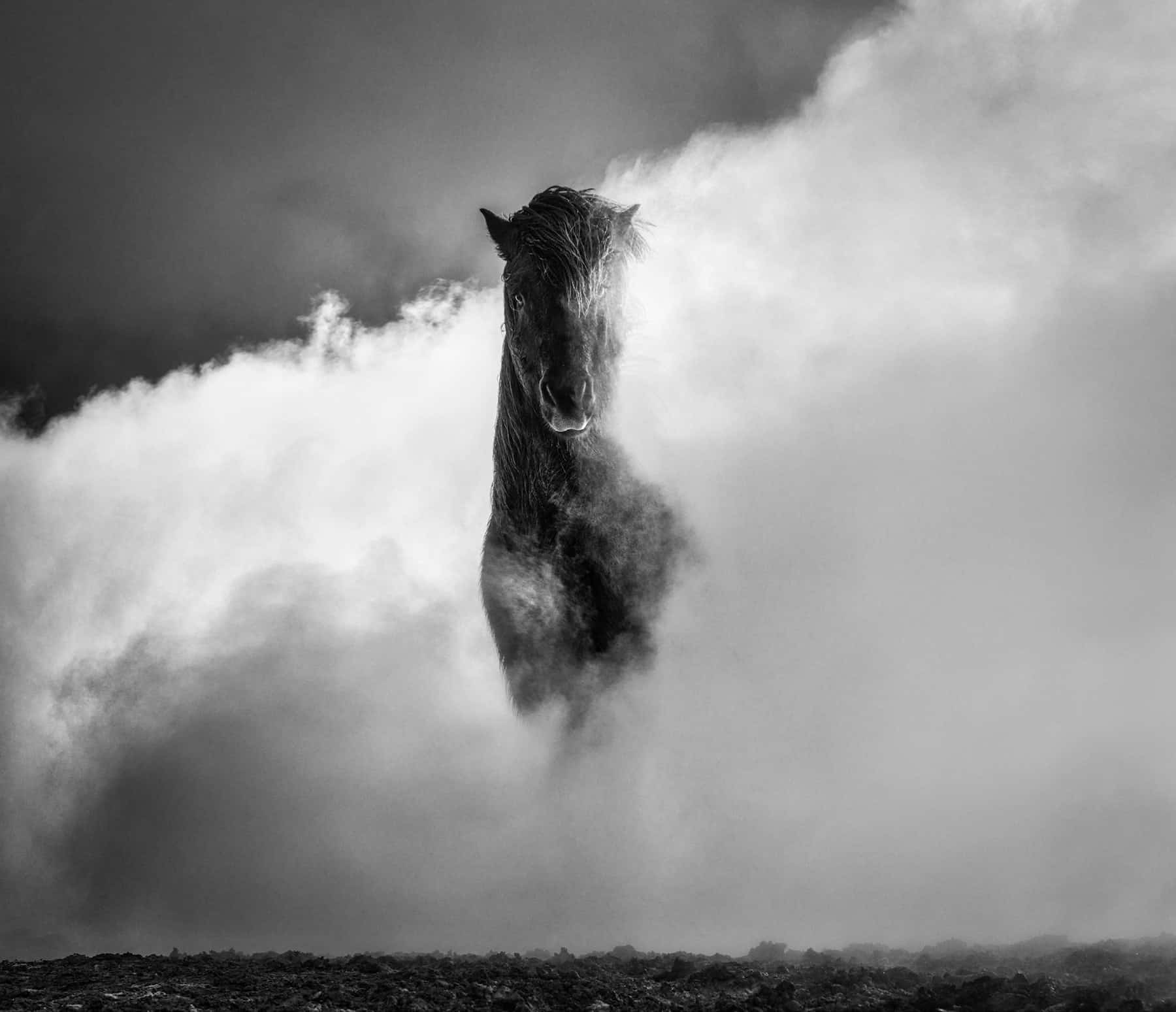
66 Degrees North
Námafjall Geothermal Area, Iceland – 2022
Archival Pigment Print on 315gsm Hahnemühle Photo Rag Baryta Paper
“Developing a concept that ticks the boxes creatively and then executing that concept are emphatically two different jobs, which is why making a picture is a longer process than taking a picture.
Many years ago, the exceptional work of British photographer Tim Flach, drew my attention to the hot springs of Myvatn in the north of Iceland. This remote area is geologically angry and in deep winter it is fairly inhospitable, but in the summer, it becomes something of a tourist resort for the local Icelandics and all too crowded for how we operate. We would always choose inhospitable over crowded.
I have filmed here in the winter in the past, but struggled to do justice to the uniquely raw ecosystem. As always there is an element of knowing how to get it right by initially getting it hopelessly wrong. In particular, this is not a safe place without engaging locals, because the ground underneath, much like Yellowstone in Wyoming, is not to be taken for granted. To be brave and work close to the geysers needs permits and guides.
But in 2022, we finally had our rewards. The weather plays such a big role in the field; no more so than up here at 66 degrees north where the Norse Gods granted my wish for strong winds and good light. It was the wind that amplified the trail of steam and allowed me to work a comfortable distance from the source without losing the effect. It was then up to me to work the strong late afternoon light to the best of my advantage.
The end result is a strong image and certainly authentic. Its stripped back and visceral mood lives and breathes the wildest of Icelandic sagas. There are horse portraits and then there are horse portraits.”
Available sizes
Each is signed, dated and numbered on the front.
Standard - Edition of 12
- 48" x 54" inches framed
Large - Edition of 12
- 67" x 76" inches framed
We ship worldwide and use a multitude of providers to safely deliver your masterpiece. Domestic delivery and installation may also be available via Hilton Asmus Contemporary’s private art shuttle. Please inquire.
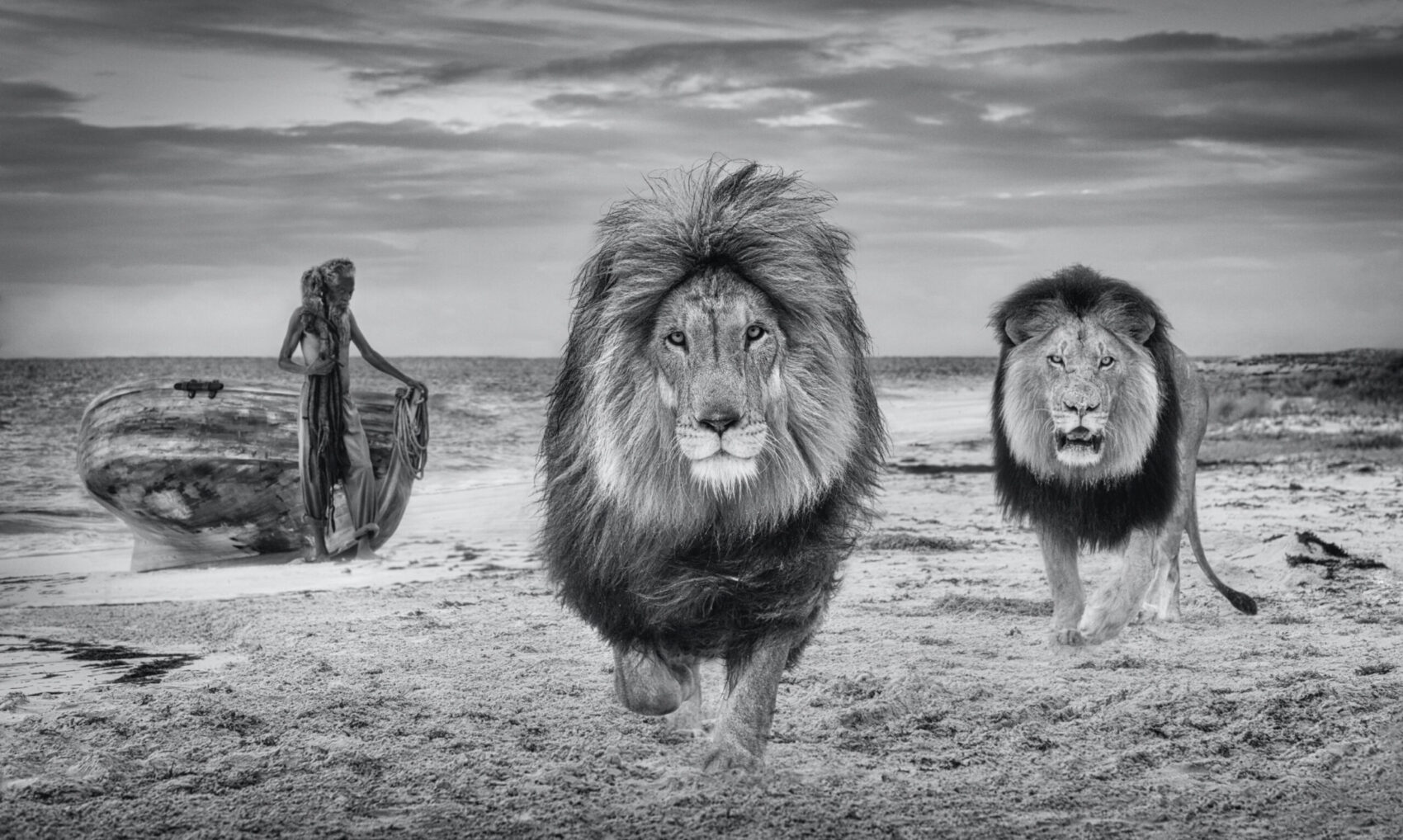
The Old Man And The Sea
Anguilla and South Africa – 2022
Archival Pigment Print on 315gsm Hahnemühle Photo Rag Baryta Paper
“He no longer dreamed of storms, nor of women, nor of great occurrences, nor of great fish, nor fights, nor contests of strength, nor of his wife. He only dreamed of places now and of the lions on the beach.”
Ernest Hemingway – The Old Man and the Sea – 1952
The success of The Old Man and the Sea – Hemingway’s last novel – made him an international celebrity. The book, which won the Pulitzer Prize in 1953, tells the story of Santiago, an ageing, experienced fisherman who has gone eighty-four days without catching a fish.
In the famous prose copied above, the lions symbolise Santiago’s lost youth as well as his pride (a group of lions being a “pride”). In this way, the lions also symbolise Santiago’s affinity with nature. Now that Santiago is no longer young, and has lost his friends, family, and strength, he sees the lions only in his dreams.
I have long wanted to tell this story in my own way, with the lions I work with in Kevin Richardson’s sanctuary, of which I am proud to be an ambassador. My friendship with Kevin goes back a long way and the mutual trust allows us to explore creative ideas that would otherwise be over ambitious.
When shooting a composite image like this, I prefer to shoot almost sequentially; the longer the gap and the moment can be lost. I saw an opportunity in January 2022 to shoot the beach scene in the Caribbean and then within the week complete the job in South Africa.
We were in Anguilla working on our Pirates of the Caribbean project and Hemingway was never far from my mind, after all Cuba, where he wrote and located the book, was less than 1000 miles away. Early on in our Anguilla adventure, I met Tasha, an old Rastafarian fisherman boasting the longest hair I had ever seen in a man and I knew immediately that he was my Santiago.
He was a filmmaker’s gold so long as you caught him before his first strong joint of the day, around 6.30 am, but luckily that was exactly the time I wanted to shoot in order to eliminate directional ambient light.
My guidance to Tasha was to look like he was half awake and dreaming. There has never been an easier direct to an actor in film history as this is after all his default position. With little trouble, I left the Caribbean with my first piece of the jigsaw.
Only five days later we were in South Africa and an enormous canvas from my shoot with ‘Santiago’ had already been erected in the veldt. In front of the canvas the production team had made a beach resembling the white beaches of Anguilla. I recognise that over the years, production has become easier as we work with the very best of the best wherever we go and it does make a difference.
The final piece of the jigsaw was the hardest. Hemingway talked of lions – not a single lion – and I knew therefore that I needed two male lions in the frame if my interpretation of Santiago’s dream was to be pure.
Kevin walks his lions out most days, so they were used to early morning exercise; the only change this time was that there was a third party in a cage and a beach 100 miles from Pretoria – a first for Transvaal!
The end result gives me pleasure. It tells the story of The Old Man and the Sea as well as I could have hoped.
Available sizes
LARGE: Edition of 12 + 3 AP
- Image Size: 56” x 93" in (142.24 cm x 236.22 cm)
- Framed Image: 71” x 108” in (180.34 cm x 274.32 cm)
STANDARD: Edition of 12 + 3 AP
- Image Size: 37” x 62” in (93.98 cm x 157.48 cm)
- Framed Image: 52” x 77" in (132.08 cm x 195.58 cm)
We ship worldwide and use a multitude of providers to safely deliver your masterpiece. Domestic delivery and installation may also be available via Hilton Asmus Contemporary’s private art shuttle. Please inquire.
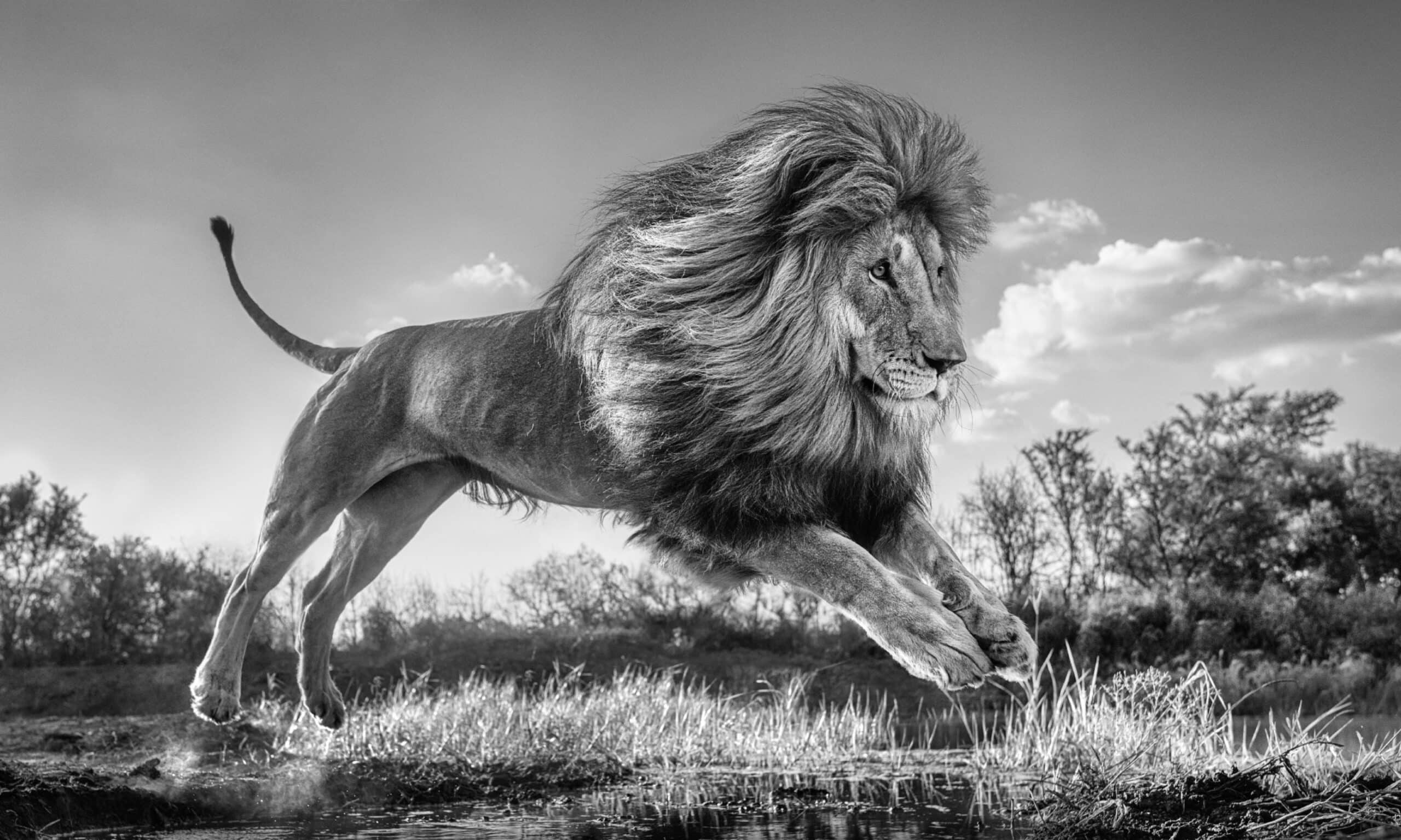
Succession
Dinokeng, South Africa – 2022
Archival Pigment Print on 315gsm Hahnemühle Photo Rag Baryta Paper
It’s been quite a revelation to work with Nikon’s new flagship camera, the Z9, in Africa this week. I don’t think photography is really about cameras, but having said that, this new model is so damn good, I can’t really imagine life without it and that’s after just four days in the field.
Speaking of which, I can’t imagine life without Kevin Richardson – The Lion Whisperer. We have worked together now for eight years, and the length of that friendship has fostered both trust and understanding. This image from last night is fairly special and is a testimony to the relationship; well that and a camera body that performs exceptionally in the most challenging of briefs.
Kevin continues to do so much to raise awareness of the plight of the lion and I am fortunate to have him in my life. Without him, there is no picture.
We have entitled this image Succession in part because Nikon’s history moves on again and iconic bodies that I have used like the FM2, the F3 and the D850 must now raise their hats to the greatest camera in Nikon’s history. The name is also fitting because the lion in this image – Yame – rescued some years ago from a discredited petting centre in Spain has succeeded Thor and Vayetse as being the poster lion within Kevin’s care and an ambassador for lions everywhere. He is in sensational condition and is just a little handsome – as this photograph shows.
Available sizes
Standard - Edition of 12
- 48" x 73" inches framed (3” Mat)
- 52” x 74” inches framed (5” Mat)
Large - Edition of 12
- 67" x 104" inches framed (3” Mat)
- 71” x 108" inches framed (5” Mat)
We ship worldwide and use a multitude of providers to safely deliver your masterpiece. Domestic delivery and installation may also be available via Hilton Asmus Contemporary’s private art shuttle. Please inquire.
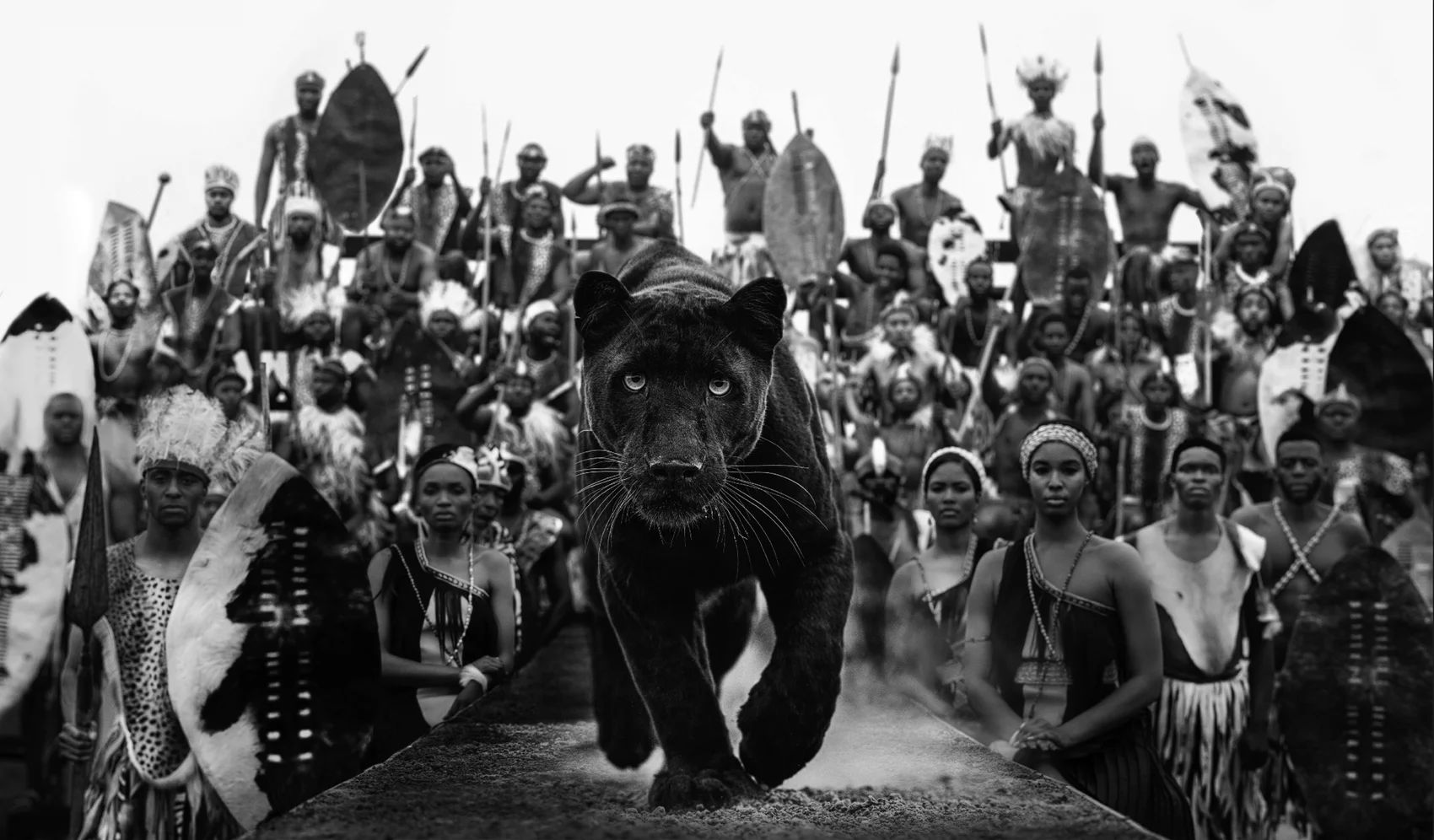
I Am Black Panther
Dinokeng, South Africa – 2021
Archival Pigment Print
The creative concept was to build a set in South Africa that allowed for a sense of collective tribal adulation. After all, our lead would be Wakanda – the superhero. Zulus seemed the right choice of tribe; they live locally to the shoot and are excitable and energized, especially when asked to go back in time and celebrate their rich heritage. It was not hard to find 100 extras, even with a 2 am pick up.
Kevin Richardson – The Lion Whisperer – looks after a handful of black leopards in his sanctuary and as with his lions, there is no possibility for anyone other than Kevin to be in an open area with them. Black leopards are part of the panther family and can give a human a very nasty bite. They should not be underestimated and safety is always the primary concern. It is, however, possible to work from inside a heavy cage and that was the path we chose for this set.
My preference is to shy away from long lenses and magnification if possible and this tends to mean being close to the lead subject. The cat moves so quickly that depth of field will always need to be sacrificed for shutter speed. It is a balancing act, as this image is nothing without the chaos behind and this needs to be given some detail. The more context that I could include, the wider the narrative and the fuller the story.
The Superhero movie Black Panther was a colossal success, grossing over $1.4bn and my instincts were to try to make a cinematic image fit for a wide screen. There needed to be Zulus to the left, to the right and most certainly above and behind – a visual human vortex of strength and territorial-ism. In this work, there is a palpable sense of trespassing into another world – a Marvel world.
The Africa I know is chaotic, frenzied and often daunting. This photograph leans on these references. Of course, there are pockets of serenity – but not for this storyline.
AVAILABLE SIZES:
Large: Edition of 20 + 3 AP
- Image Size: 56” x 96” in (142.24 cm x 243.84 cm)
- Framed Image: 71” x 111” in (180.34 cm x 281.94 cm)
Standard: Edition of 20 + 3 AP
- Image Size: 37” x 63” in (93.98 cm x 160.02 cm)
- Framed Image: 52” x 78” in (132.08 cm x 198.12 cm)
We ship worldwide and use a multitude of providers to safely deliver your masterpiece. Domestic delivery and installation may also be available via Hilton Asmus Contemporary’s private art shuttle. Please inquire.
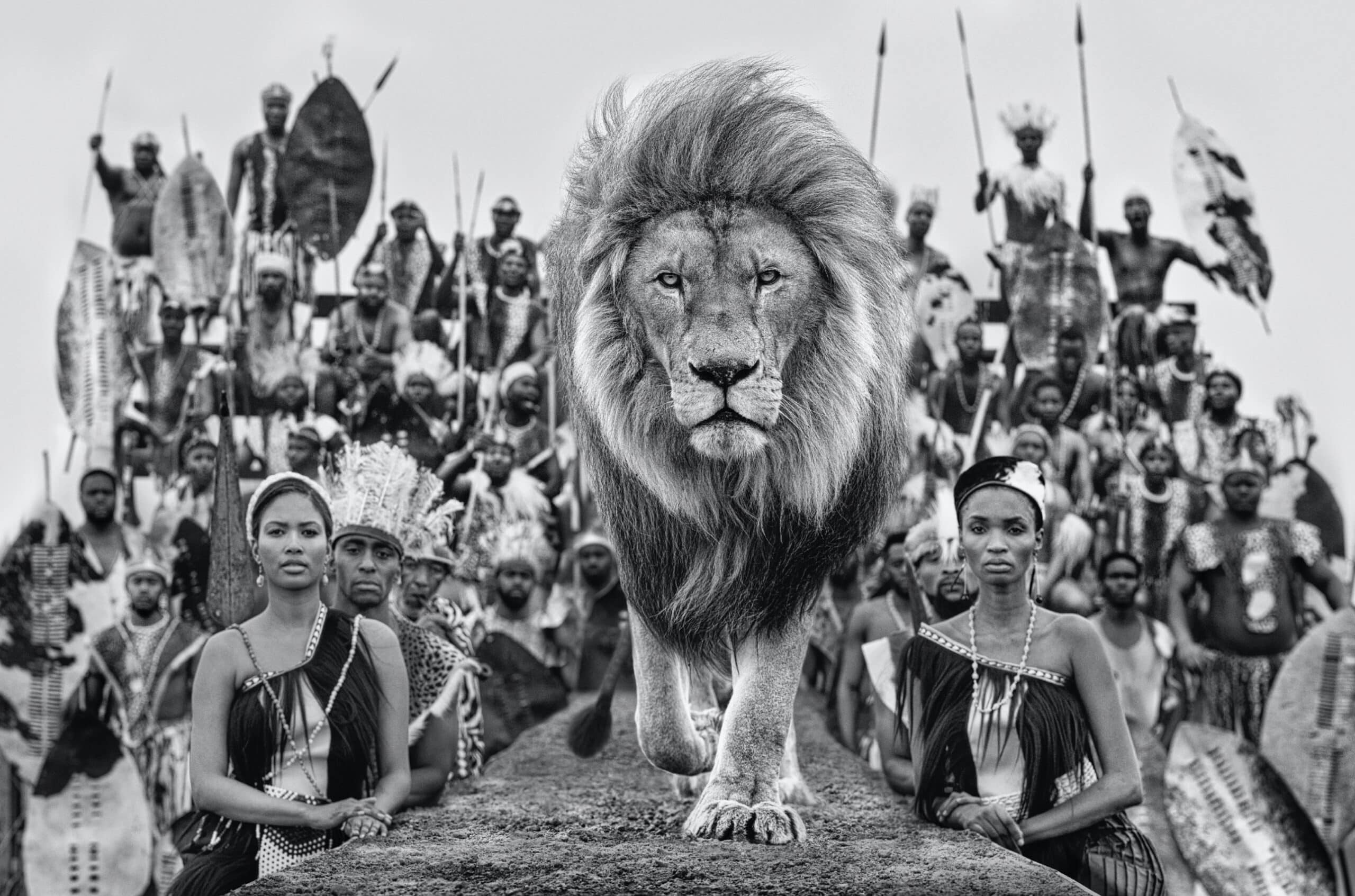
Catwalk
Dinokeng, South Africa – 2021
Archival Pigment Print
In early 2015, I took a photograph in an old saloon high in the mountains of western Montana. The image of a large adult wolf walking purposefully towards my camera, whilst life in the bar continued as normal behind him, became coveted. I was flattered that the last available edition sold for $100,000 at Sotheby’s a few years later. I think the price paid was a tribute to the magnificence of the wolf as much as it was to the authenticity of the concept.
There was a compositional balance to that image and whilst the barman and the customers were way out of the focal range of the camera lens, their anonymity added to the narrative and didn’t detract the eye from the wolf. Focus can deliberately exclude as well as include, and in layered images such as the Wolf of Main Street, this approach works well as it directs the viewer without losing the wider story. In retrospect, the photograph was a pivotal moment in my career and the barman that day – Thomas Rosenthal – has become a dear friend and is now part of the DY production team in America.
We borrowed from the depth offered by that saloon in many sets around the world over the next few years. Whilst I am all for fresh challenges, if a concept works, I tend to go back. In 2021 my ambition was to leverage my long-term relationship with Kevin Richardson – The Lion Whisperer – to create something special in his lion sanctuary north east of Pretoria. The project was delayed by COVID as South Africa only really opened up in the autumn, but this gave the original premise time to marinate in my mind. I wanted to glorify the lion’s splendour – as did Kevin – but I also wanted to build a much wider story around the key subject.
As we spitballed a few ideas around, two governing principles became clear. The first was that the lion could only be on set if I was in a cage and no one, other than Kevin, was in his domain. This is not just for safety reasons, it is also because we had to remove any conceivable distraction for Vayetse, my go to lion within Kevin’s care. The second conclusion was that we should build a set predicated on compositional mathematics before anything else. In other words, I knew my lens and camera settings before we started construction, not on the week of the shoot. There was a great deal of creative processing long before we arrived in South Africa as this was very much a picture that was going to be made, not taken.
In building the story, my instincts were to play on the vibe of a Paris Catwalk – after all, we had access not just to any cat to strut down our catwalk, but the King of Africa; a magnificent adult male lion. I have been to enough fashion shows in my life to know that it’s a theatre and the attendees tend to be united in their passion and behaviour. There may be more cultural refinement in the Paris fashion shows than at a club football match, but both theatres attract collective tribes.
This prompted me to indulge with the idea that we should incorporate a tribal crowd into the set – albeit a literal tribe not a metaphorical one. We were certainly in the right part of the world, the heartland of the Zulu people. The largest ethnic group and nation in South Africa, with an estimated population of 10-12 million, was within a morning’s drive of where we were shooting.
My plan was to bring around 100 adult Zulus to the set – all dressed in traditional attire and armed with spears and shields. The word went out and we had no shortage of applicants. With each and every member of the cast, we discussed whether there were any cultural appropriation issues in asking them to dress traditionally. As I have found with Native Americans, they said it would be a celebration of their culture; of which they were rightly proud.
To many the word “Zulu” evokes memories of Michael Cain in the 1964 British epic war film depicting the Battle of Rorke’s Drift between the British Army and the Zulus. Luckily that battle was 140 years ago and the script has changed. The Zulus on set could not have been more cooperative with this Brit and there was a carnival mood at breakfast despite many of them having been picked up at home at 2 am. It was one of the more memorable mornings of my career to be able to immerse myself in the uplifting energy of Zulu life.
Available sizes
Large: Edition of 20 + 3 AP
- Image Size: 56” x 85” in (142.24 cm x 215.9 cm)
- Framed Image: 71” x 100” in (180.34 cm x 254 cm)
Standard: Edition of 20 + 3 AP
- Image Size: 37” x 56” in (93.98 cm x 142.24 cm)
- Framed Image: 52” x 71” in (132.08 cm x 180.34 cm)
We ship worldwide and use a multitude of providers to safely deliver your masterpiece. Domestic delivery and installation may also be available via Hilton Asmus Contemporary’s private art shuttle. Please inquire.
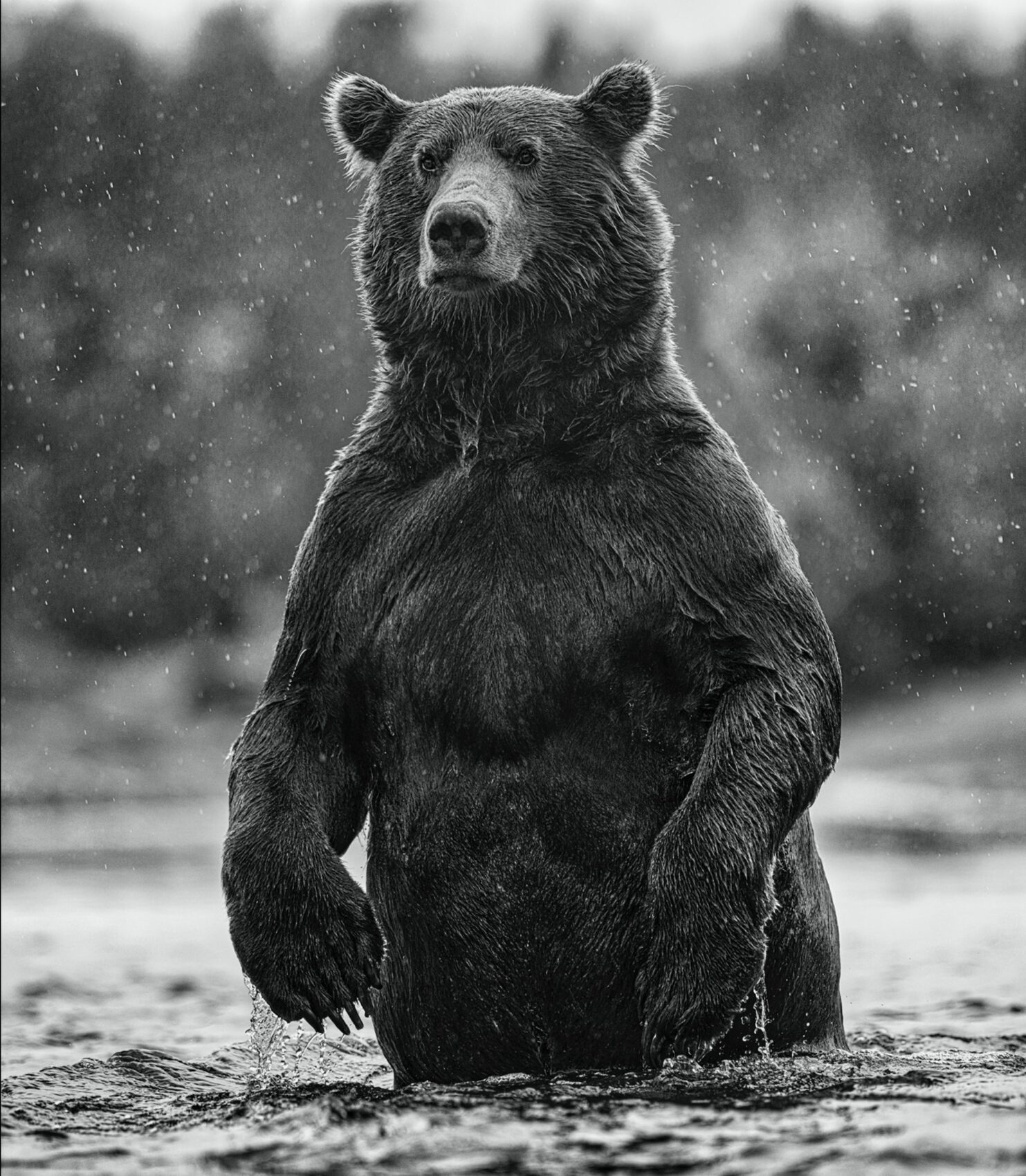
Brutus
Brutus
Alaska, USA – 2021
This is a huge coastal bear; a living version of the stuffed ones that adorn the airports of lodges and airports in Alaska. They are bigger on the coast than in the inland tundra and that draws me to areas such as Kamishak Bay and the river that runs into it.
Adult bears draw our breath the most when they are standing as that is when their shoulders, their bulk and their menace are amplified. The average adult male coastal bear weighs five times as much as an average adult man and in many bear pictures – including the majority of mine – this is not adequately conveyed. Sometimes a wet bear can look a bit like an oversized dog and leave the cameraman frustrated that the encounter has been disserved.
But not here. A true first for me and an encounter I will long remember. There was a huge amount of luck involved and then at the key moment, just a little steel. I am low in the water and the bear is towering above me – there is no room for camera shake.
It was a fairly miserable day weather wise, but actually I think that the rainfall helps the image. Sometimes I work in a studio, but this was about as far from a studio as it is possible to be.
AVAILABLE SIZES:
LARGE - Edition of 12 + 3 AP:
- Image Size: 64” x 56" in (162.56 cm x 142.24 cm)
- Framed Image: 79” x 71” in (200.66 cm x 180.34 cm)
STANDARD - Edition of 12 + 3 AP:
- Image Size: 43” x 37" in (109.22 cm x 93.98 cm)
- Framed Image: 58" x 52" (147.32 cm x 132.08 cm)
We ship worldwide and use a multitude of providers to safely deliver your masterpiece. Domestic delivery and installation may also be available via Hilton Asmus Contemporary’s private art shuttle. Please inquire.
Pebble Beach
Pebble Beach
Alaska, USA – 2021
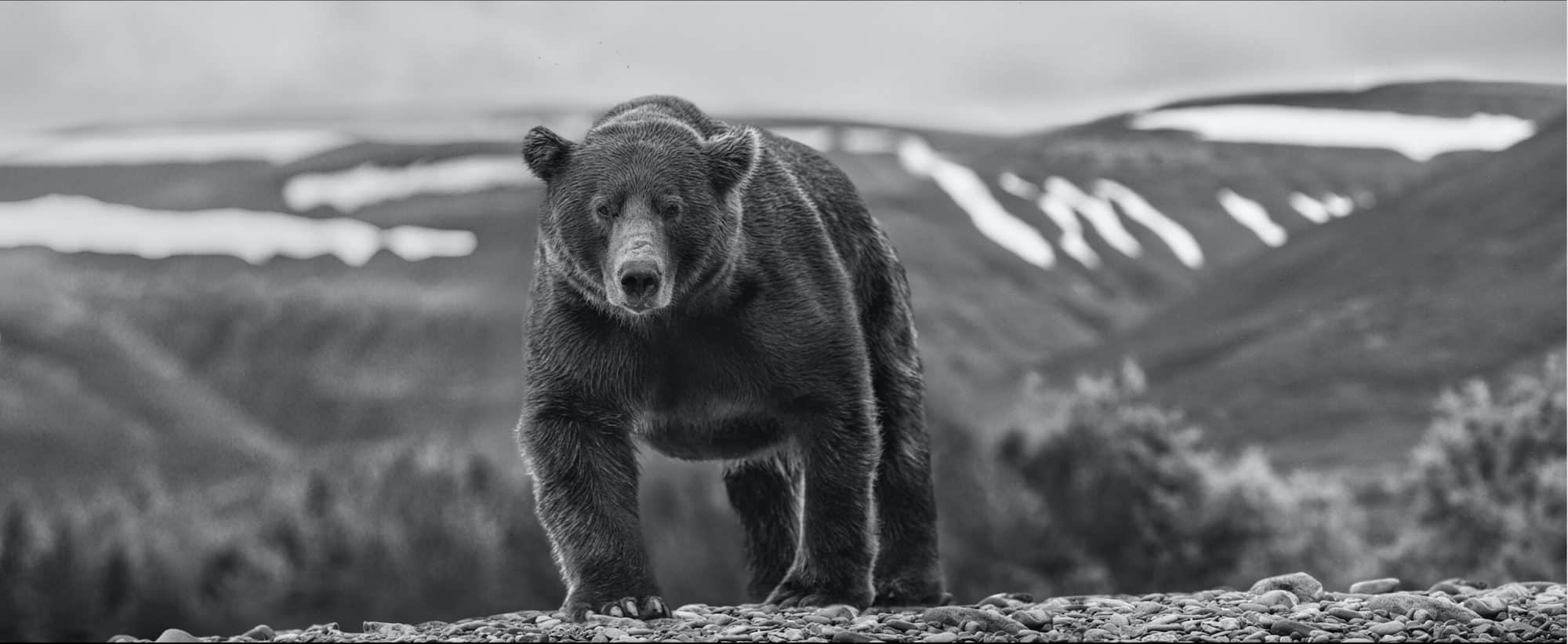
I think two elements often need to coalesce to create a memorable bear image in Alaska; proximity to a big brute of a bear in the first place and then a transcending level of context. I have come close before, but never emphatically nailed it. We have had far more failure than success.
Then in mid-August 2021 I had my moment. These types of portraits demand a wider narrative and the snow and the mountains give a very clear nod to life in the final frontier. I still can’t quite believe our luck, but then again, we have put in the hours up here over the years.
I am crystal clear in my mind who I have to thank for this capture; our mountain guide Connor Ketchum. We had worked with him before and knew that his instinctive reaction and control of the river boat were of Olympic standard. He knows the fast-flowing river and its varying depth well and can manœuvre his boat with speed and sensitivity to a bear’s behaviour. Without his skill we would never have had the bear in this position with the mountain range behind.
The pebble beach above the river bank offered a wonderful stage for the bear to visually “pop” against a stunning backdrop, but we had to get there in seconds and Connor achieved this with grace and precision. Most importantly of all, by turning the engine off and drifting into position, the bear’s behaviour was unaffected. He just walked regally towards us in his role of “Boss of the river”. Had his path altered as a result of our presence, there would have been no picture. The game was won by speed and stealth.
In the summer of 2021, we used bush pilots over a dozen times in Alaska and had some disheartening days. That is the nature of the game, but on our final day we had this two-minute encounter at the edge of the world. It made everything worthwhile and we thank our friend from Arkansas – the legend that is Connor Ketchum. Without him there was no photograph and we are again reminded of the people that help us on a daily basis.
AVAILABLE SIZES:
LARGE - Edition of 12:
- Image: 40” x 98" (102 cm x 249 cm)
- Framed: 51” x 109" (127 cm x 277 cm)
STANDARD - Edition of 12:
- Image: 27” x 66" (69 cm x 168 cm)
- Framed: 38” x 77" (97 cm x 381 cm)
We ship worldwide and use a multitude of providers to safely deliver your masterpiece. Domestic delivery and installation may also be available via Hilton Asmus Contemporary’s private art shuttle. Please inquire.
Mars Attacks!
Sea of Cortez, Mexico – 2021
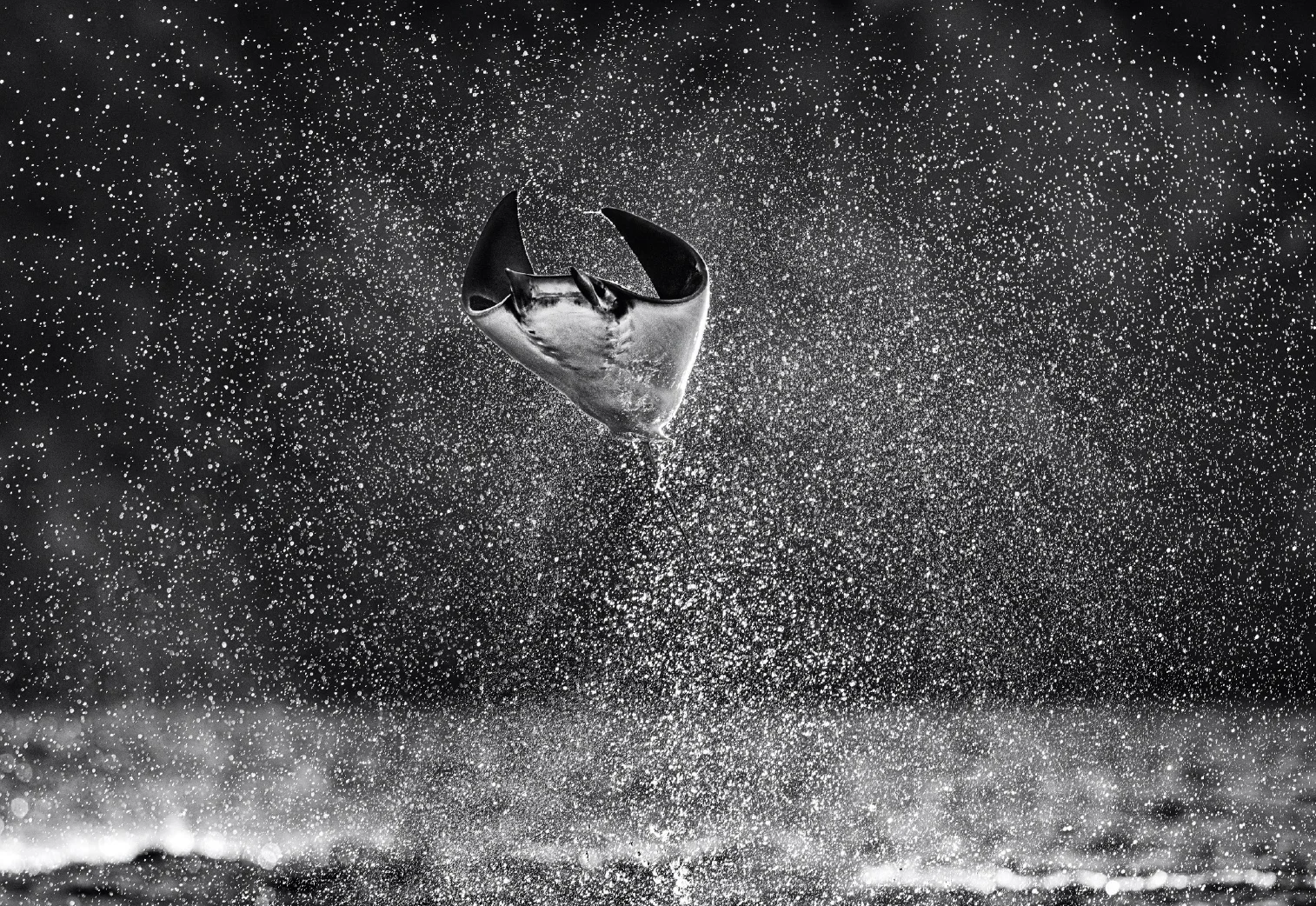
Every year in the early summer, thousands of mobula rays congregate in the Sea of Cortez off the coast of La Paz in Mexico. On calm days at sea, a spectacular courting ritual unfolds during which the rays show off by jumping several metres out of the sea. It is one of the most surreal sights to witness anywhere in the world. In the ocean, mobula rays look as one would expect, but when flying through the air, they look like aliens or spaceships. They are quite literally a fish out of water. I have no preconception as to what a “Mars Attack” might look like, but this is hopefully the closest I will get to it.
There are a few dilemmas on this location for the filmmaker. Firstly, the action often takes place 90 minutes from port and the light and the activity are at their best in the hour before sunset. We also discovered that the wind picks up after the sun sets. Secondly, I wanted to be as low as possible and this ruled out hiring larger more comfortable boats.
There was no way we would sacrifice content, so we had no choice but to spend a few dark evenings returning home in quite rough seas in a small fishing boat. But that was still the right trade. There are no shortcuts in this gig.
I took a great deal of frames over the week, but it is such a low percentage assignment that just three or four did justice to the spectacle. It requires quick reactions and – as always – good fortune. Much depends on the alertness and manoeuvering skills of the captain of the boat. I was fortunate to work in La Paz with my fellow Londoner – Luke Inman – who now lives in the city and knows the sea and sealife there as well as anyone. He hired the boat captain – Tony Ruelas – and this picture is as much his as it is mine.
What a planet we live on.
AVAILABLE SIZES:
Standard
- Image Size: 37” x 54"
- Framed with a 3” Mat: 48” x 65"
- Framed with a 5” Mat: 52” x 69"
Large
- Image Size: 56” x 82"
- Framed with a 3” Mat: 67” x 93"
- Framed with a 5” Mat: 71” x 97"
We ship worldwide and use a multitude of providers to safely deliver your artwork. Domestic delivery and installation may also be available via Hilton Contemporary’s private art shuttle. Please inquire.