
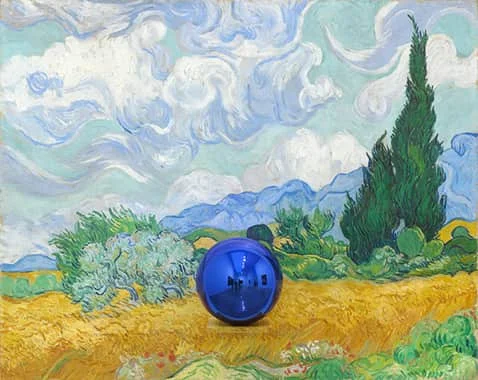
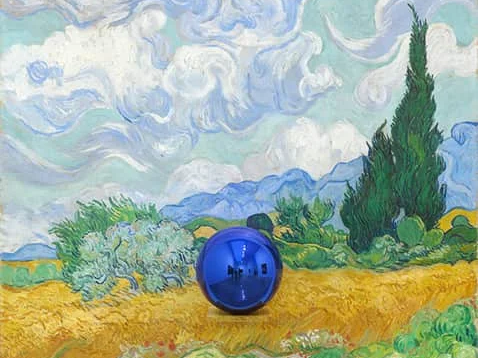
Gazing Ball (Van Gogh Wheatfield with Cypresses)

Gazing Ball (Van Gogh Wheatfield with Cypresses)
Archival Pigment Print on Innova rag paper, glass
The Gazing Ball print series is a continuation of Jeff Koons’ painting and sculpture series of the same name, in which the artist references masterpieces from art history paired with a highly reflective, cobalt blue gazing ball.
The Gazing Ball pieces trigger questions about the inherent dialogue between art works and their viewers in the most tangible way, as the viewers see themselves encapsulated within each work. Reflecting the onlookers’ physicality, Koons’s globes serve as portals, guiding viewers into these often misunderstood masterpieces, where art history meets contemporary pop culture, while never avoiding the viewer’s own visage in the engagement and experience of these famous pieces. For Koons, the act of viewing these pieces is as essential as their own objective histories, and while he cannot force a conversation face to face with each original simultaneously, the presentation here is an excellent start.
– Art Observed December 2015
In conceiving the Gazing Ball print series, Koons imagined the prints’ reflective element as being perfectly flat and almost imperceptibly thin. To meet these criteria, he collaborated with the research lab at Corning, a 166-year-old company with unparalleled expertise in glass science and optical physics. The result, produced by the Corning Specialty Glass Plant in Bagneaux sur Loing, France, is a custom-poured, optically perfect, one-millimeter thick circle of mirrored cobalt blue glass.
Looking at the Gazing Ball works, the viewer sees oneself reflected in the mirrored surface at the same time as one sees the print. This juxtaposition of art historical reference with the viewer’s present-day reflection invites a dialogue about the meaning of time and how we transcend it. “This experience is about you,” says Koons, “your desires, your interests, your participation, your relationship with this image.” He says that the images he used—some of the most famous in art history—are not intended to represent the canon, but are rather “works that I enjoy… my cultural DNA.” He also points out that many of the artists referred to in the series have influenced one another: “Monet is always referencing Rubens… Manet is referencing Raphael… Everybody enjoyed Titian.”
The Gazing Ball print series raises important questions about the act of looking, reflection (actual and metaphorical), and the relationship between the pictures. This is “not about being a copy,” Koons says. “This is about this union, the concept of participating. Everybody’s in this dialogue of sharing enjoyment and pleasure.”
Available size - Edition of 20
- 35.5 in x 41 in (90 x 104 cm)
We ship worldwide and use a multitude of providers to safely deliver your masterpiece. Domestic delivery and installation may also be available via Hilton Asmus Contemporary’s private art shuttle. Please inquire.

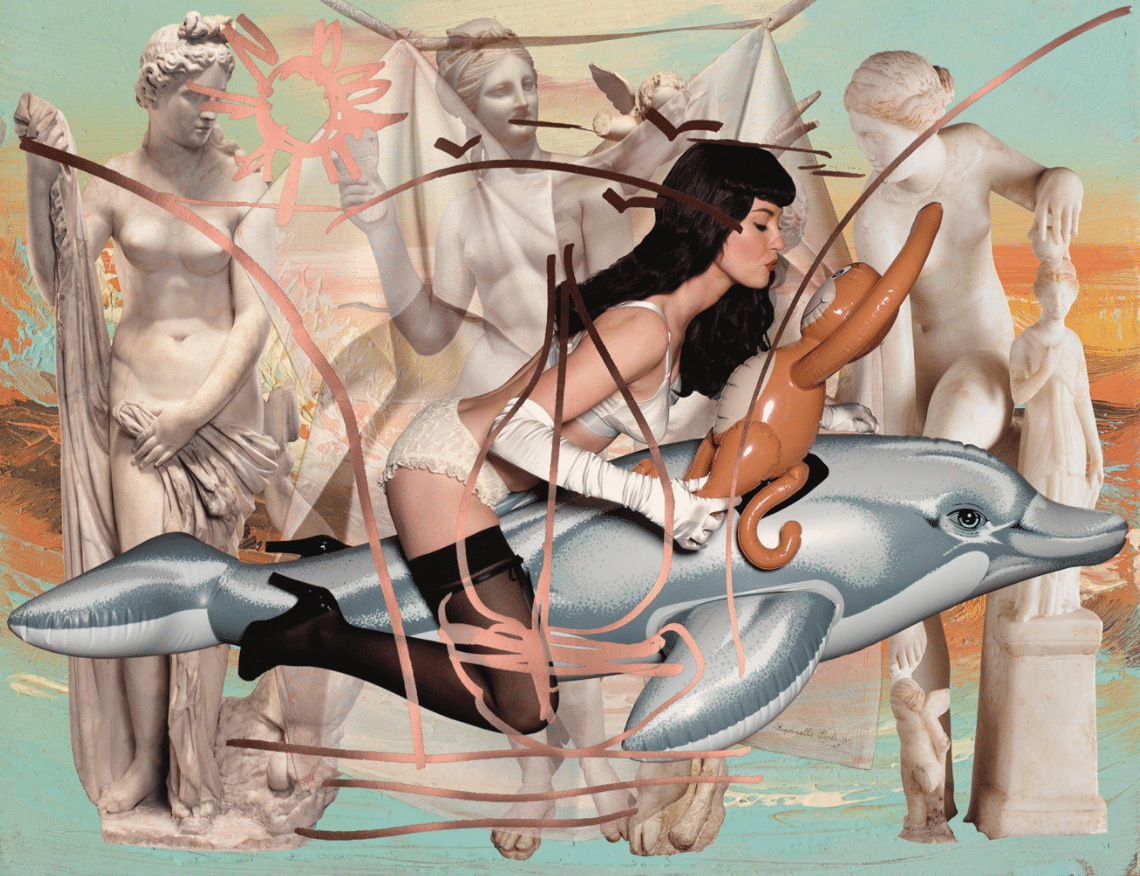
Antiquity 3, 2019
Antiquity 3, 2019
Archival Pigment Print on Innova rag paper, glass
The Gazing Ball print series is a continuation of Jeff Koons’ painting and sculpture series of the same name, in which the artist references masterpieces from art history paired with a highly reflective, cobalt blue gazing ball.
The Gazing Ball pieces trigger questions about the inherent dialogue between art works and their viewers in the most tangible way, as the viewers see themselves encapsulated within each work. Reflecting the onlookers’ physicality, Koons’s globes serve as portals, guiding viewers into these often misunderstood masterpieces, where art history meets contemporary pop culture, while never avoiding the viewer’s own visage in the engagement and experience of these famous pieces. For Koons, the act of viewing these pieces is as essential as their own objective histories, and while he cannot force a conversation face to face with each original simultaneously, the presentation here is an excellent start.
– Art Observed December 2015
In conceiving the Gazing Ball print series, Koons imagined the prints’ reflective element as being perfectly flat and almost imperceptibly thin. To meet these criteria, he collaborated with the research lab at Corning, a 166-year-old company with unparalleled expertise in glass science and optical physics. The result, produced by the Corning Specialty Glass Plant in Bagneaux sur Loing, France, is a custom-poured, optically perfect, one-millimeter thick circle of mirrored cobalt blue glass.
Looking at the Gazing Ball works, the viewer sees oneself reflected in the mirrored surface at the same time as one sees the print. This juxtaposition of art historical reference with the viewer’s present-day reflection invites a dialogue about the meaning of time and how we transcend it. “This experience is about you,” says Koons, “your desires, your interests, your participation, your relationship with this image.” He says that the images he used—some of the most famous in art history—are not intended to represent the canon, but are rather “works that I enjoy… my cultural DNA.” He also points out that many of the artists referred to in the series have influenced one another: “Monet is always referencing Rubens… Manet is referencing Raphael… Everybody enjoyed Titian.”
The Gazing Ball print series raises important questions about the act of looking, reflection (actual and metaphorical), and the relationship between the pictures. This is “not about being a copy,” Koons says. “This is about this union, the concept of participating. Everybody’s in this dialogue of sharing enjoyment and pleasure.”
Available size - Edition of 20
- 38 1/2 in x 50 in; (97.8 cm x 127 cm)
We ship worldwide and use a multitude of providers to safely deliver your masterpiece. Domestic delivery and installation may also be available via Hilton Asmus Contemporary’s private art shuttle. Please inquire.

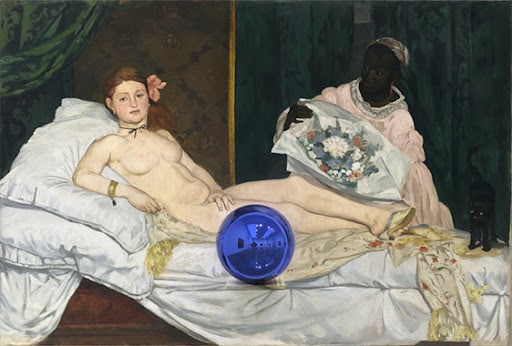
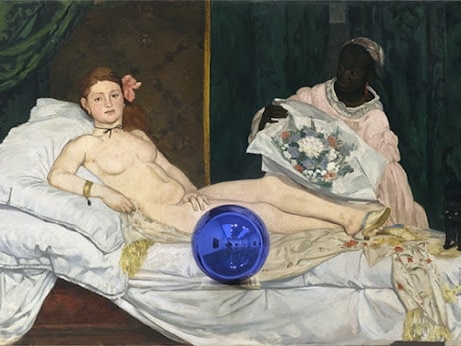
Gazing Ball (Manet Olympia), 2017
Gazing Ball (Manet Olympia), 2017
Archival Pigment Print on Innova rag paper, glass
The Gazing Ball print series is a continuation of Jeff Koons’ painting and sculpture series of the same name, in which the artist references masterpieces from art history paired with a highly reflective, cobalt blue gazing ball.
The Gazing Ball pieces trigger questions about the inherent dialogue between art works and their viewers in the most tangible way, as the viewers see themselves encapsulated within each work. Reflecting the onlookers’ physicality, Koons’s globes serve as portals, guiding viewers into these often misunderstood masterpieces, where art history meets contemporary pop culture, while never avoiding the viewer’s own visage in the engagement and experience of these famous pieces. For Koons, the act of viewing these pieces is as essential as their own objective histories, and while he cannot force a conversation face to face with each original simultaneously, the presentation here is an excellent start.
– Art Observed December 2015
In conceiving the Gazing Ball print series, Koons imagined the prints’ reflective element as being perfectly flat and almost imperceptibly thin. To meet these criteria, he collaborated with the research lab at Corning, a 166-year-old company with unparalleled expertise in glass science and optical physics. The result, produced by the Corning Specialty Glass Plant in Bagneaux sur Loing, France, is a custom-poured, optically perfect, one-millimeter thick circle of mirrored cobalt blue glass.
Looking at the Gazing Ball works, the viewer sees oneself reflected in the mirrored surface at the same time as one sees the print. This juxtaposition of art historical reference with the viewer’s present-day reflection invites a dialogue about the meaning of time and how we transcend it. “This experience is about you,” says Koons, “your desires, your interests, your participation, your relationship with this image.” He says that the images he used—some of the most famous in art history—are not intended to represent the canon, but are rather “works that I enjoy… my cultural DNA.” He also points out that many of the artists referred to in the series have influenced one another: “Monet is always referencing Rubens… Manet is referencing Raphael… Everybody enjoyed Titian.”
The Gazing Ball print series raises important questions about the act of looking, reflection (actual and metaphorical), and the relationship between the pictures. This is “not about being a copy,” Koons says. “This is about this union, the concept of participating. Everybody’s in this dialogue of sharing enjoyment and pleasure.”
Available size - Edition of 20
- 35 7/16 in x 48 5/8 in; (90 cm x 123.5 cm)
We ship worldwide and use a multitude of providers to safely deliver your masterpiece. Domestic delivery and installation may also be available via Hilton Asmus Contemporary’s private art shuttle. Please inquire.

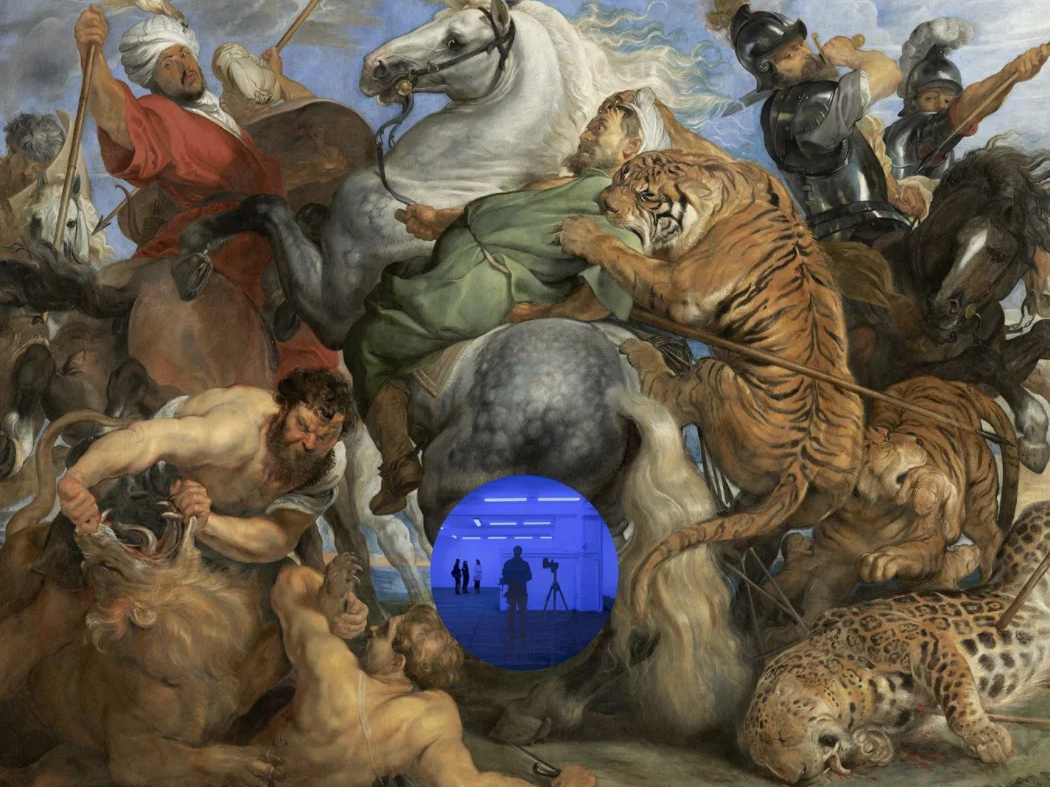
Gazing Ball (Rubens Tiger Hunt), 2017
Gazing Ball (Rubens Tiger Hunt), 2017
Archival Pigment Print on Innova rag paper, glass
The Gazing Ball print series is a continuation of Jeff Koons’ painting and sculpture series of the same name, in which the artist references masterpieces from art history paired with a highly reflective, cobalt blue gazing ball.
The Gazing Ball pieces trigger questions about the inherent dialogue between art works and their viewers in the most tangible way, as the viewers see themselves encapsulated within each work. Reflecting the onlookers’ physicality, Koons’s globes serve as portals, guiding viewers into these often misunderstood masterpieces, where art history meets contemporary pop culture, while never avoiding the viewer’s own visage in the engagement and experience of these famous pieces. For Koons, the act of viewing these pieces is as essential as their own objective histories, and while he cannot force a conversation face to face with each original simultaneously, the presentation here is an excellent start.
– Art Observed December 2015
In conceiving the Gazing Ball print series, Koons imagined the prints’ reflective element as being perfectly flat and almost imperceptibly thin. To meet these criteria, he collaborated with the research lab at Corning, a 166-year-old company with unparalleled expertise in glass science and optical physics. The result, produced by the Corning Specialty Glass Plant in Bagneaux sur Loing, France, is a custom-poured, optically perfect, one-millimeter thick circle of mirrored cobalt blue glass.
Looking at the Gazing Ball works, the viewer sees oneself reflected in the mirrored surface at the same time as one sees the print. This juxtaposition of art historical reference with the viewer’s present-day reflection invites a dialogue about the meaning of time and how we transcend it. “This experience is about you,” says Koons, “your desires, your interests, your participation, your relationship with this image.” He says that the images he used—some of the most famous in art history—are not intended to represent the canon, but are rather “works that I enjoy… my cultural DNA.” He also points out that many of the artists referred to in the series have influenced one another: “Monet is always referencing Rubens… Manet is referencing Raphael… Everybody enjoyed Titian.”
The Gazing Ball print series raises important questions about the act of looking, reflection (actual and metaphorical), and the relationship between the pictures. This is “not about being a copy,” Koons says. “This is about this union, the concept of participating. Everybody’s in this dialogue of sharing enjoyment and pleasure.”
Available size - Edition of 20
- 40 5/16 in x 49 5/8 in; (102.4 cm x 126 cm)
We ship worldwide and use a multitude of providers to safely deliver your masterpiece. Domestic delivery and installation may also be available via Hilton Asmus Contemporary’s private art shuttle. Please inquire.
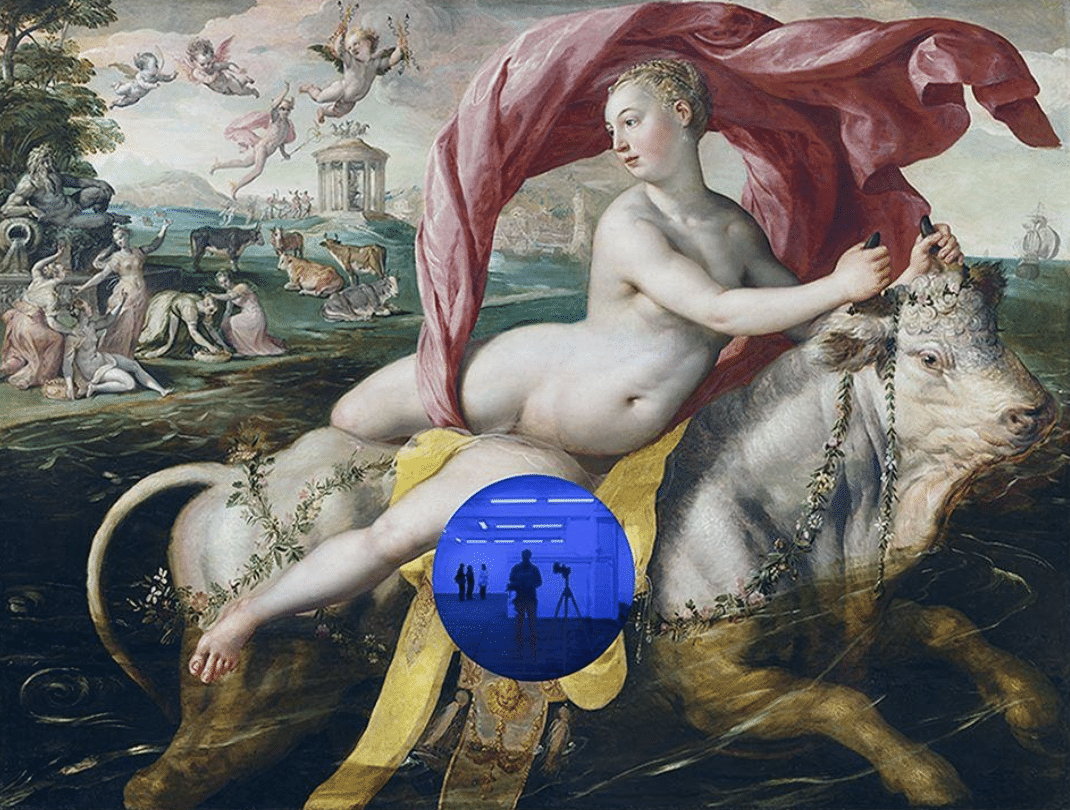
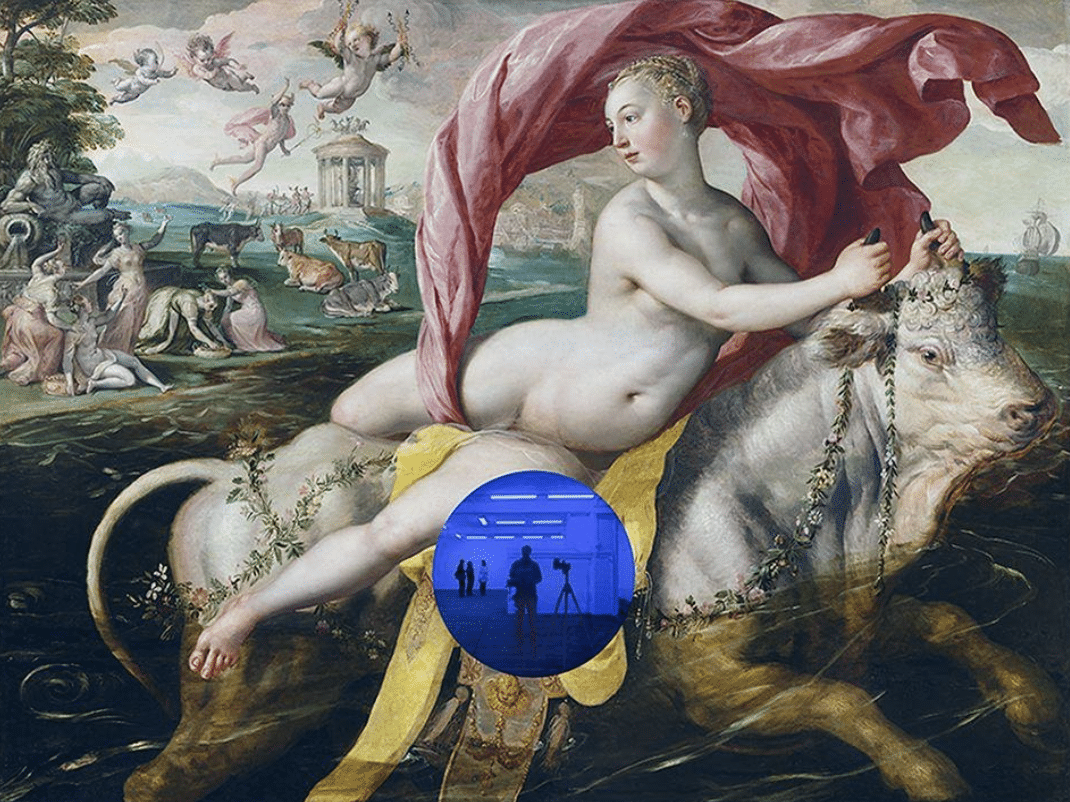
Gazing Ball (de Vos Europa), 2018
Gazing Ball (de Vos Europa), 2018
Archival Pigment Print on Innova rag paper, glass
The Gazing Ball print series is a continuation of Jeff Koons’ painting and sculpture series of the same name, in which the artist references masterpieces from art history paired with a highly reflective, cobalt blue gazing ball.
The Gazing Ball pieces trigger questions about the inherent dialogue between art works and their viewers in the most tangible way, as the viewers see themselves encapsulated within each work. Reflecting the onlookers’ physicality, Koons’s globes serve as portals, guiding viewers into these often misunderstood masterpieces, where art history meets contemporary pop culture, while never avoiding the viewer’s own visage in the engagement and experience of these famous pieces. For Koons, the act of viewing these pieces is as essential as their own objective histories, and while he cannot force a conversation face to face with each original simultaneously, the presentation here is an excellent start.
– Art Observed December 2015
In conceiving the Gazing Ball print series, Koons imagined the prints’ reflective element as being perfectly flat and almost imperceptibly thin. To meet these criteria, he collaborated with the research lab at Corning, a 166-year-old company with unparalleled expertise in glass science and optical physics. The result, produced by the Corning Specialty Glass Plant in Bagneaux sur Loing, France, is a custom-poured, optically perfect, one-millimeter thick circle of mirrored cobalt blue glass.
Looking at the Gazing Ball works, the viewer sees oneself reflected in the mirrored surface at the same time as one sees the print. This juxtaposition of art historical reference with the viewer’s present-day reflection invites a dialogue about the meaning of time and how we transcend it. “This experience is about you,” says Koons, “your desires, your interests, your participation, your relationship with this image.” He says that the images he used—some of the most famous in art history—are not intended to represent the canon, but are rather “works that I enjoy… my cultural DNA.” He also points out that many of the artists referred to in the series have influenced one another: “Monet is always referencing Rubens… Manet is referencing Raphael… Everybody enjoyed Titian.”
The Gazing Ball print series raises important questions about the act of looking, reflection (actual and metaphorical), and the relationship between the pictures. This is “not about being a copy,” Koons says. “This is about this union, the concept of participating. Everybody’s in this dialogue of sharing enjoyment and pleasure.”
Available size - Edition of 20
- 36 3/8 x 46 1/4 inches; (92.4 cm x 117.5 cm)
We ship worldwide and use a multitude of providers to safely deliver your masterpiece. Domestic delivery and installation may also be available via Hilton Asmus Contemporary’s private art shuttle. Please inquire.

Gazing Ball (Manet Luncheon on the Grass), 2019
Gazing Ball (Manet Luncheon on the Grass), 2019
Archival Pigment Print on Innova rag paper, glass
The Gazing Ball print series is a continuation of Jeff Koons’ painting and sculpture series of the same name, in which the artist references masterpieces from art history paired with a highly reflective, cobalt blue gazing ball.
The Gazing Ball pieces trigger questions about the inherent dialogue between art works and their viewers in the most tangible way, as the viewers see themselves encapsulated within each work. Reflecting the onlookers’ physicality, Koons’s globes serve as portals, guiding viewers into these often misunderstood masterpieces, where art history meets contemporary pop culture, while never avoiding the viewer’s own visage in the engagement and experience of these famous pieces. For Koons, the act of viewing these pieces is as essential as their own objective histories, and while he cannot force a conversation face to face with each original simultaneously, the presentation here is an excellent start.
– Art Observed December 2015
In conceiving the Gazing Ball print series, Koons imagined the prints’ reflective element as being perfectly flat and almost imperceptibly thin. To meet these criteria, he collaborated with the research lab at Corning, a 166-year-old company with unparalleled expertise in glass science and optical physics. The result, produced by the Corning Specialty Glass Plant in Bagneaux sur Loing, France, is a custom-poured, optically perfect, one-millimeter thick circle of mirrored cobalt blue glass.
Looking at the Gazing Ball works, the viewer sees oneself reflected in the mirrored surface at the same time as one sees the print. This juxtaposition of art historical reference with the viewer’s present-day reflection invites a dialogue about the meaning of time and how we transcend it. “This experience is about you,” says Koons, “your desires, your interests, your participation, your relationship with this image.” He says that the images he used—some of the most famous in art history—are not intended to represent the canon, but are rather “works that I enjoy… my cultural DNA.” He also points out that many of the artists referred to in the series have influenced one another: “Monet is always referencing Rubens… Manet is referencing Raphael… Everybody enjoyed Titian.”
The Gazing Ball print series raises important questions about the act of looking, reflection (actual and metaphorical), and the relationship between the pictures. This is “not about being a copy,” Koons says. “This is about this union, the concept of participating. Everybody’s in this dialogue of sharing enjoyment and pleasure.”
Available size - Edition of 20
- 39 1/16 x 48 inches (99.2 x 121.9 cm)
We ship worldwide and use a multitude of providers to safely deliver your masterpiece. Domestic delivery and installation may also be available via Hilton Asmus Contemporary’s private art shuttle. Please inquire.
Jeff Koons
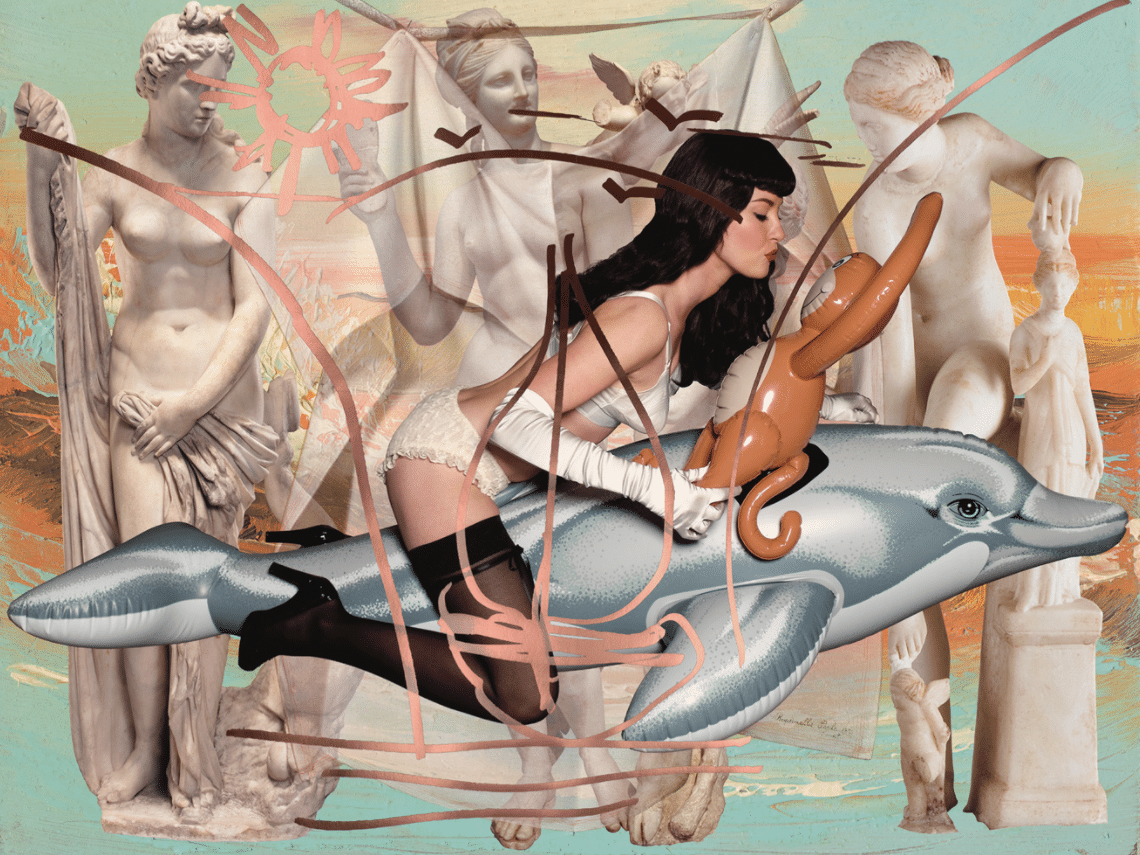

Jeff Koons (born 1955) is widely regarded as one of the most influential and controversial artists of the post-war era. His universally recognizable style is a mix of surrealism, dada, and pop, resulting in bold paintings and monumental sculptures that comment on contemporary culture. Koons draws attention to the continuity of images throughout time, merging art historical references with images of everyday objects and engaging the viewer in a metaphysical dialogue with cultural history.
Koons’ first solo exhibition took place at the New Museum in New York in 1980. Since then he has been the focus of exhibitions around the world, including the Museum of Contemporary Art, Chicago; San Francisco Museum of Art; Stedelijk Museum, Amsterdam; Whitney Museum of American Art, New York; Centre Georges Pompidou, Paris; Guggenheim Museum, Bilbao; Fondation Beyeler, Basel; Château de Versailles; Victoria and Albert Museum, London; and the Chosun Ilbo Art Museum, Seoul among others.