

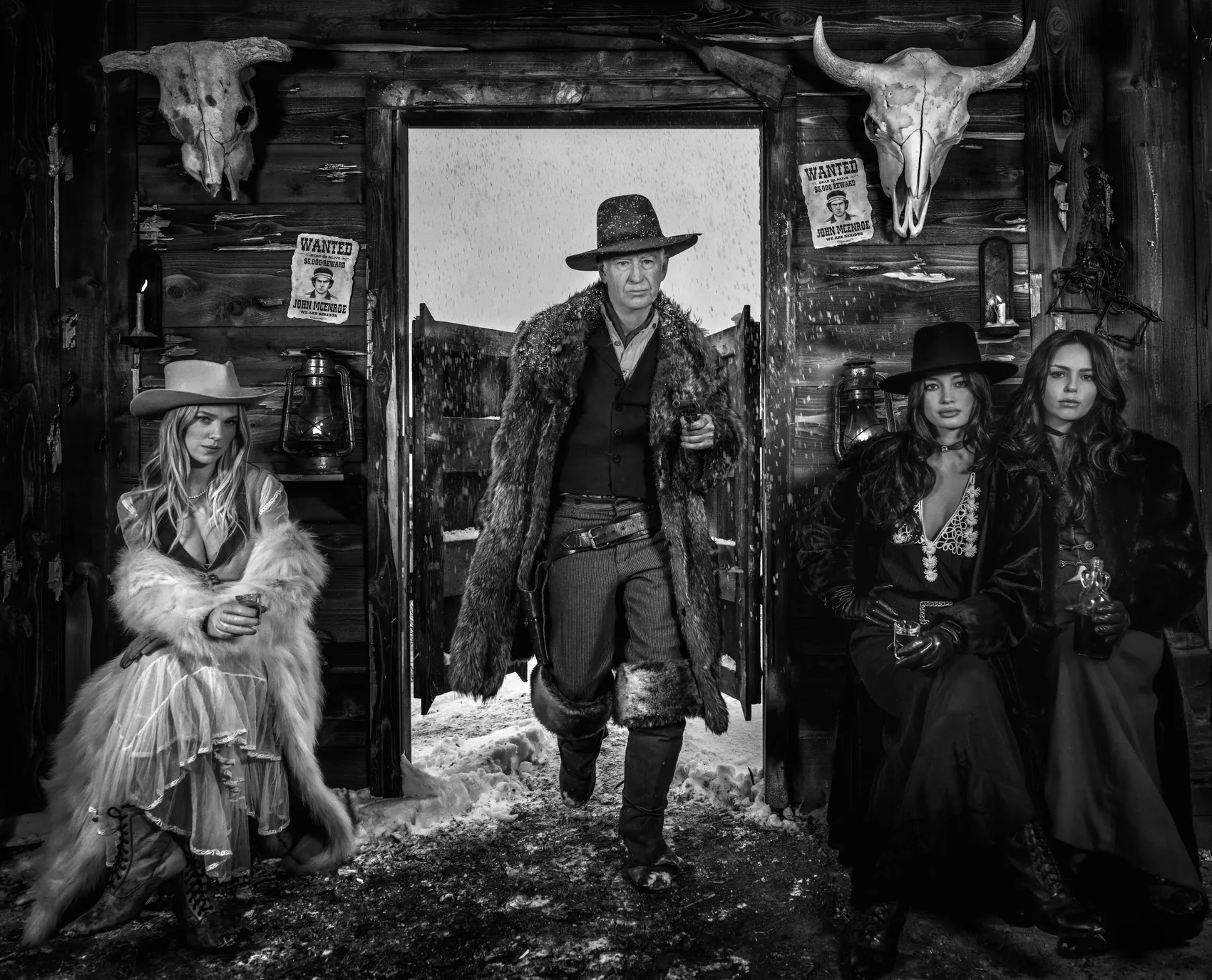
The Wanted
Jackson Hole, Wyoming – 2025
“John McEnroe was never an easy man to govern; he had too much armoury on the tennis court for his opponents and too much attitude off it for officialdom. He was an untamed street fighter who did not like to be told what to do and this inevitably led to moments of tension. McEnroe was pure box office and there has never really been anyone since.
It was this context that prompted me to cast him as a gunslinging outlaw in the chaotic and bloody days of the Wild West. He seemed to fit the bill much better than most of his contemporaries (though to his point – Jimmy Connors – ran him close).
I understood that the faux saloon we built in the Tetons of Wyoming would have a wider narrative if there was some sense of place and indeed a sense of the cold. There needed to be a fusion of the inside and the outside – never the simplest of tricks.
We ended up building the structure very close to where Tarantino shot the winter seasons in Django – I sense that he is not a bad judge of locations.
John was a leftie with a tennis racket and, of course, he instinctively picked up this pistol with his left hand. As with Wimbledon over 40 years ago, his presence holds court – there is a palpable sense of menace.“
-David Yarrow
AVAILABLE SIZES:
Standard: Edition of 20 + 3 APs
- Image Size: 37" x 46" in (94 cm × 178 cm)
- Framed Image: 52" x 61" in (132 cm × 155 cm)
Large: Edition of 20 + 3 APs
- Image Size: 56" x 70" in (142.24 cm × 117 cm)
- Framed Image: 71" x 85" in (180 cm × 216 cm)
We ship worldwide and use a multitude of providers to safely deliver your masterpiece. Domestic delivery and installation may also be available via Hilton Asmus Contemporary’s private art shuttle. Please inquire.
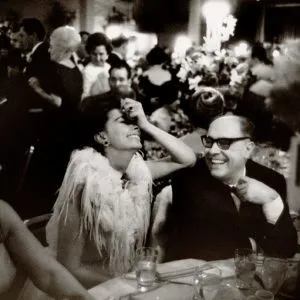
Sophia Loren and Carlo Ponti at the Academy Awards Dinner, 1962
Sophia Loren and Carlo Ponti at the Academy Awards Dinner, 1962
Sophia Loren and Carlo Ponti Academy Awards Dinner 1962 captures an intimate moment between one of cinema’s most iconic actresses and the influential producer who shaped much of her career. Photographed during an Academy Awards dinner in Hollywood, the image offers a rare glimpse into the social world behind the ceremony, where glamour softened into candid connection.
Sophia Loren appears relaxed and expressive, leaning back with an air of confidence and ease. Her posture reflects a woman fully aware of her place in cinema history, yet comfortable away from the spotlight of the stage. Carlo Ponti sits beside her, smiling with quiet satisfaction. His presence is understated but assured, reflecting his role as both creative partner and guiding force behind Loren’s international success.
The Academy Awards dinner was a pivotal space in Hollywood’s golden age. It functioned as a meeting ground for actors, directors, producers, and studio power brokers. In Sophia Loren and Carlo Ponti Academy Awards Dinner 1962, that environment is palpable. The background hum of conversation, formal attire, and table settings frames a moment that feels personal rather than performative.
This photograph speaks to the intersection of love, ambition, and artistry. Ponti was instrumental in helping Loren transition from Italian cinema to global stardom. By 1962, she had already become an international icon, and this image reflects the confidence of a career in full ascent. The relaxed intimacy between the pair suggests partnership rather than spectacle.
Compositionally, the photograph balances movement and stillness. Loren’s expressive pose contrasts with Ponti’s composed demeanor. The surrounding figures blur into atmosphere, drawing attention back to the central relationship. The soft lighting and grain emphasize texture and mood, anchoring the image firmly in its era.
As a limited edition photographic print, Sophia Loren and Carlo Ponti Academy Awards Dinner 1962 stands as a document of Hollywood history. It captures the quieter moments that shaped the industry as much as the awards themselves. The photograph preserves a fleeting exchange between two figures whose influence on cinema continues to resonate decades later.
Available sizes:
Limited Edition - Silver Gelatin Prints
- 16 x 20 inches
- 20 x 24 inches
- 30 x 40 inches
- 40 x 60 inches
We ship worldwide and use a multitude of providers to safely deliver your artwork. Domestic delivery and installation may also be available via Hilton Contemporary’s private art shuttle. Please inquire.
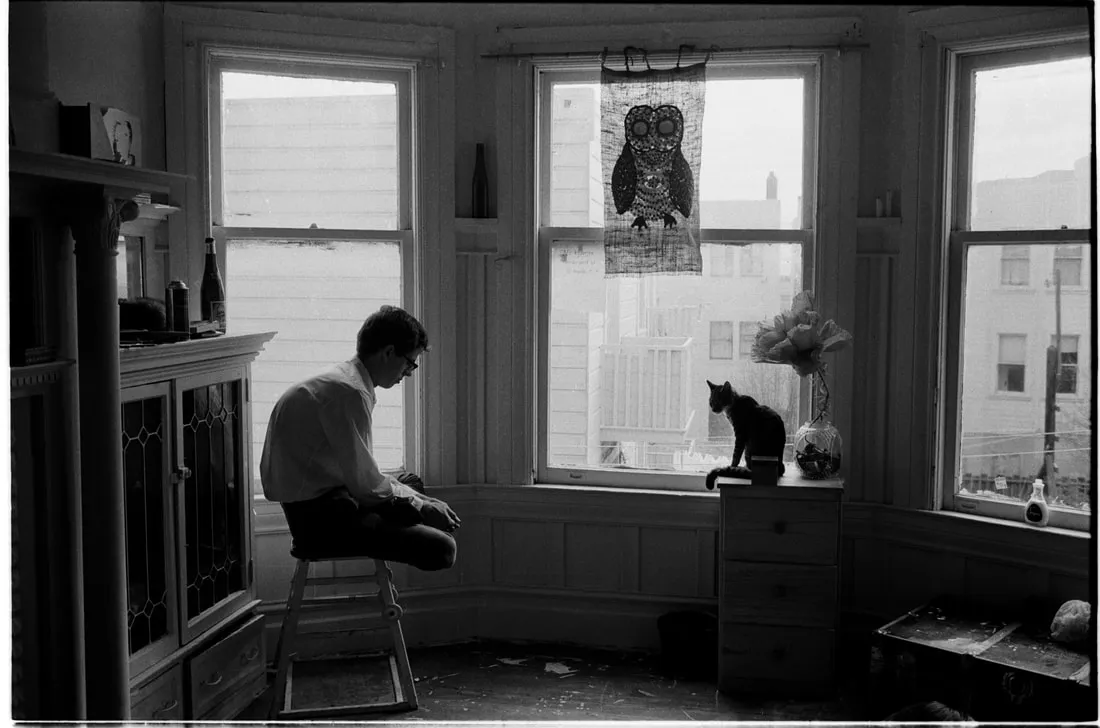
San Francisco Mathematician on LSD with His Cat, 1966
San Francisco Mathematician on LSD with His Cat, 1966
San Francisco LSD mathematician with cat 1966 is a rare and quietly unsettling photograph that captures the private interior of America’s psychedelic era. Taken inside a San Francisco apartment, the image shows a mathematician seated in stillness as his cat perches nearby. Both are participating in an LSD experience, part of a ritual the subject reportedly repeated every other week.
Unlike the public spectacles often associated with 1960s counterculture, this photograph documents an inward moment. There are no crowds, music, or visual theatrics. Instead, the scene unfolds in silence. The man sits hunched forward, absorbed in thought, while the cat gazes outward from the windowsill. Light filters through tall windows, framing the pair against the geometry of the room and the city beyond.
The photograph reflects the Bay Area’s unique role in the psychedelic movement. In San Francisco, LSD experimentation often intersected with academia, philosophy, and science. Mathematicians, engineers, artists, and writers explored altered states not as rebellion alone, but as tools for introspection, pattern recognition, and expanded perception. San Francisco LSD mathematician with cat 1966 embodies that quieter intellectual strain of the era.
The presence of the cat introduces an uncanny tension. Its calm posture mirrors the man’s stillness, blurring boundaries between human consciousness and animal instinct. The image raises questions without offering answers. Is the cat aware of the altered state? Is the ritual an experiment, a meditation, or a shared routine? The photograph allows space for interpretation rather than spectacle.
Compositionally, the image is restrained and deliberate. Strong vertical lines from the windows contrast with the soft organic forms of the seated figure and the animal. Objects in the room remain sparse, reinforcing the psychological isolation of the moment. Nothing distracts from the relationship between subject, space, and state of mind.
As a limited edition photographic print, San Francisco LSD mathematician with cat 1966 stands as an important historical document. It preserves an intimate side of the psychedelic era rarely seen in mainstream imagery. The photograph resists mythology and instead offers quiet observation, making it both unsettling and deeply human.
Available sizes:
Limited Edition - Silver Gelatin Prints
- 16 x 20 inches
- 20 x 24 inches
- 30 x 40 inches
- 40 x 60 inches
We ship worldwide and use a multitude of providers to safely deliver your artwork. Domestic delivery and installation may also be available via Hilton Contemporary’s private art shuttle. Please inquire.
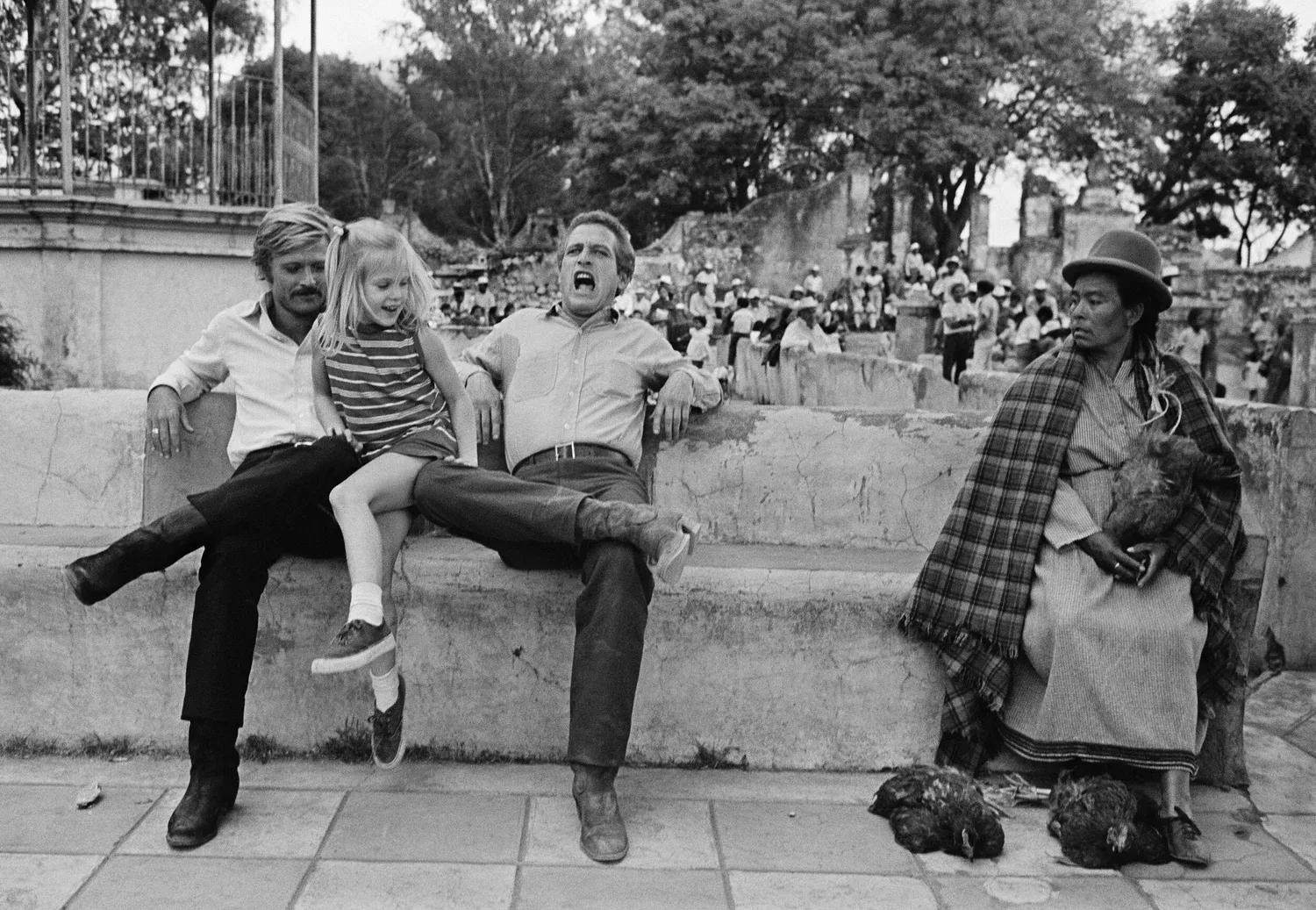
Robert Redford and Paul Newman on Set of Butch Cassidy, 1968
Robert Redford and Paul Newman on Set of Butch Cassidy, 1968
Robert Redford and Paul Newman Butch Cassidy 1968 captures an intimate and lighthearted moment between two of the most celebrated actors of their generation. Photographed in Durango, Mexico, during the production of Butch Cassidy and the Sundance Kid, the image shows Robert Redford and Paul Newman relaxing during a break on set, joined by Newman’s young daughter, Melissa.
The photograph was taken while the cast and crew paused from filming, revealing a candid glimpse behind the scenes of a landmark motion picture. Newman leans back casually, mid-expression, while Redford sits beside him, sharing the moment with ease and familiarity. Melissa Newman’s presence adds warmth and humanity, grounding the image in family life rather than performance or publicity.
Unlike staged promotional portraits, Robert Redford and Paul Newman Butch Cassidy 1968 conveys spontaneity and genuine camaraderie. The actors’ relaxed body language reflects the close bond that translated so powerfully to the screen. Their chemistry became one of the defining elements of the film and helped establish Butch Cassidy and the Sundance Kid as a cultural touchstone of late-1960s American cinema.
The setting in Durango, Mexico, played a crucial role in the film’s visual language. Its historic streets and open landscapes doubled for the American West and Bolivia, lending authenticity and texture to the story. This image situates the actors within that environment while pulling the viewer into an unguarded, human moment that exists beyond the narrative of the film itself.
Photographed for The London Sunday Times, the image also reflects a shift in editorial photography during the era. Publications increasingly favored honest, behind-the-scenes imagery over formal studio portraits. Lawrence Schiller’s approach emphasizes presence, timing, and emotional truth, allowing moments like this to unfold naturally.
As a limited edition photographic print, Robert Redford and Paul Newman Butch Cassidy 1968 stands as both a document of cinematic history and a portrait of friendship. It captures the intersection of family, work, and artistry at the height of New Hollywood, preserving a fleeting moment that continues to resonate with film lovers and collectors alike.
Available sizes:
Limited Edition - Silver Gelatin Prints
- 16 x 20 inches
- 20 x 24 inches
- 30 x 40 inches
- 40 x 60 inches
We ship worldwide and use a multitude of providers to safely deliver your artwork. Domestic delivery and installation may also be available via Hilton Contemporary’s private art shuttle. Please inquire.