
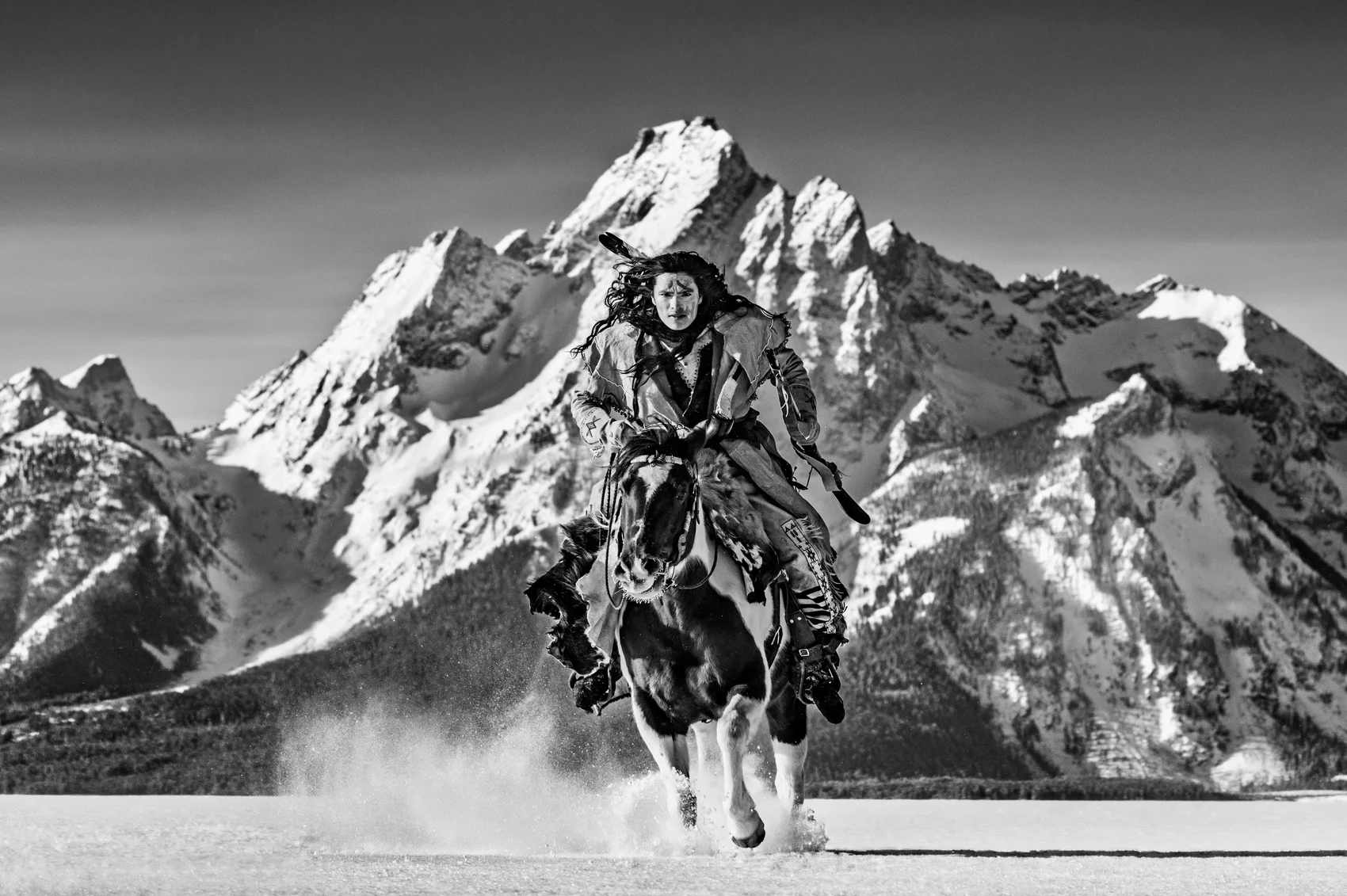
High Noon

Grand Tetons, Wyoming – 2021
“Mount Moran in the Tetons offers as good a mountain backdrop as I know in America. In the winter, in particular, it has a grandeur that is difficult to match.
The lake below this section of the Tetons is frozen thick in mid winter and offers the perfect stage on which to tell stories, but we are always mindful that on a good day, the whole scene become too bright within 45 minutes of sunrise. Images like this require very early starts and we are always in position well before dawn.
The Native Americans were introduced to horses by early Spanish immigrants and they adapted quickly to the optionality and mobility given to them by horses. The Comanche in the south became a feared and dominant tribe largely because of their horsemanship skills.
This frame – taken on a very cold morning in Wyoming – simply pays homage to a tested partnership that played a material role in shaping 19th century American history.”
-David Yarrow
AVAILABLE SIZES:
Large: Edition of 12
- Image Size: 56" x 84" in (142.24 cm x 213.36 cm)
- Framed Image: 71” x 99” in (180.34 cm x 251.46 cm)
Standard: Edition of 12
- Image Size: 37" x 56" in (93.98 cm x 142.24 cm)
- Framed Image: 52" x 71" in (132.08 cm x 180.34 cm)
We ship worldwide and use a multitude of providers to safely deliver your masterpiece. Domestic delivery and installation may also be available via Hilton Asmus Contemporary’s private art shuttle. Please inquire.

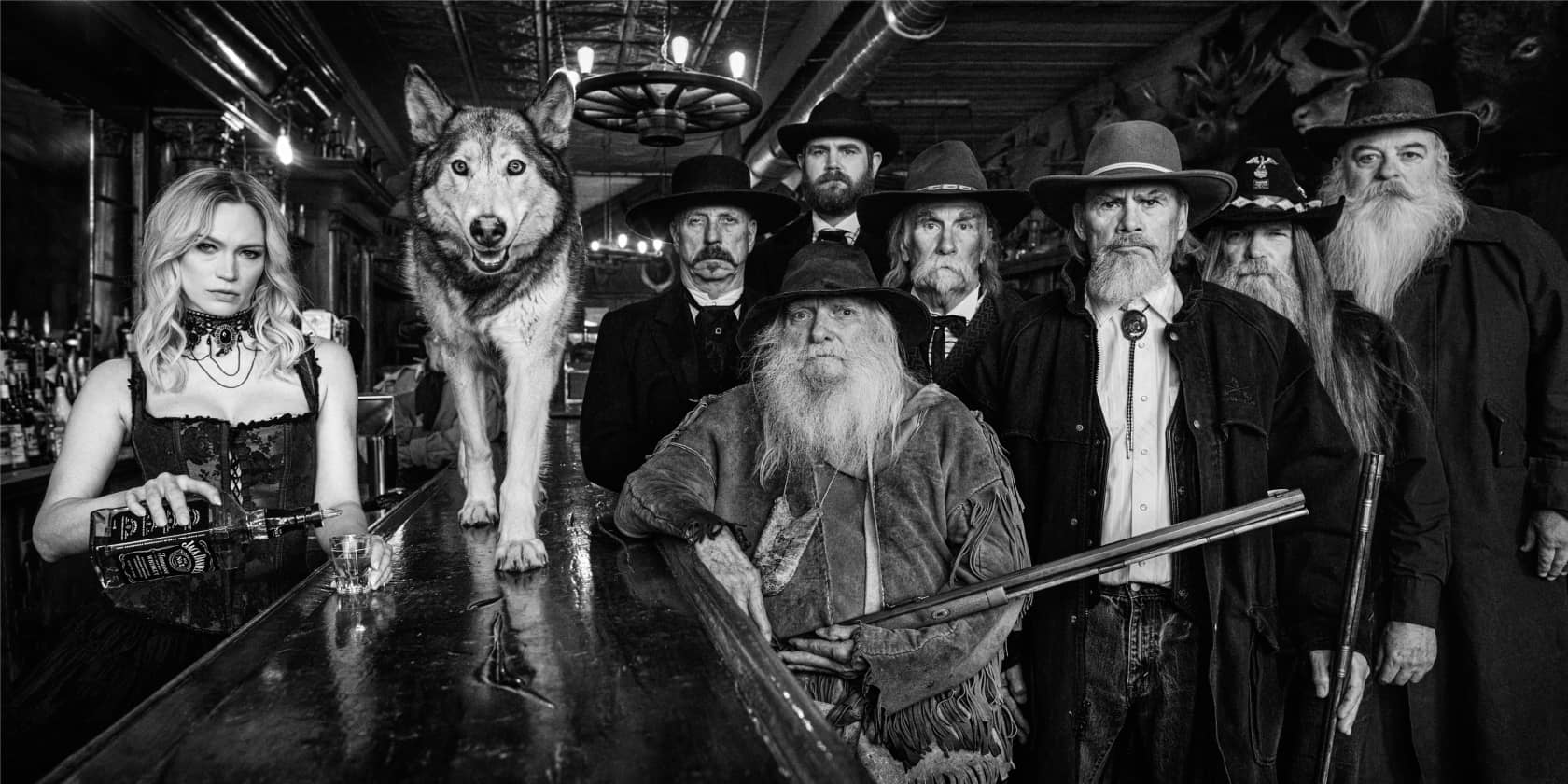
More Usual Suspects
2021
AVAILABLE SIZES:
LARGE: Edition of 12
- Image Size: 50” x 100” in (127 cm x 254 cm)
- Framed Image: 65” x 115” in (180.34 cm x 215.9 cm)
STANDARD: Edition of 12
- Image Size: 37” x 67” in (93.98 cm x 170.18 cm)
- Framed Image: 49” x 82" in (124.46 cm x 208.28 cm)
We ship worldwide and use a multitude of providers to safely deliver your masterpiece. Domestic delivery and installation may also be available via Hilton Asmus Contemporary’s private art shuttle. Please inquire.
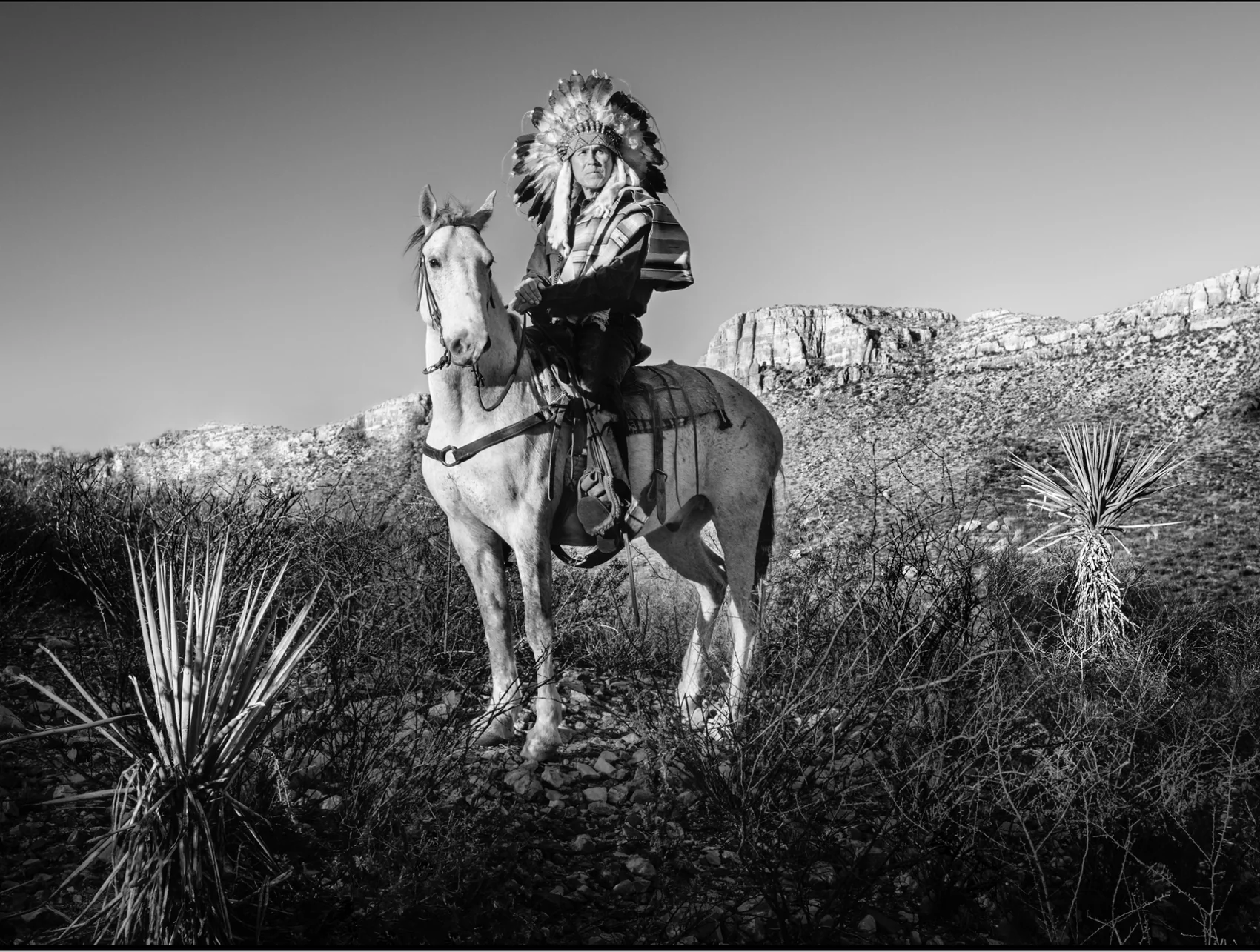
Apache
West Texas – 2021
In the 16th century, the Apache migrated south to the Texas Panhandle from what is now Canada. There they eventually encountered Mexicans; Western settlers and of course the Comanche – the most feared of the native American tribes.
The Apache wars with the US army spanned three decades of the 19th century, but it was ultimately the Comanche who pushed them further south towards the border with Mexico. Consequentially, the Apache settled the furthest south of the all Native American tribes.
In my search for the setting for this portrait, I looked for features that would readily locate the elder and his horse.
There needed to be a sense of place to lend weight to the narrative. We found this escarpment rising above cactus rich scrubland only about 40 miles north of the Rio Grande in West Texas.
The photograph was taken just a few minutes after sunrise. Out there in South West Texas the light can get a little too harsh before most folk are out of bed. As it was, we were back home by 10 am.
We want to thank our new friend Mo Brings Plenty for his help in this project.
AVAILABLE SIZES:
Standard
- Image size: 37" x 50"
- Framed with a 3" mat: 48" x 61"
- Framed with a 5" mat: 52" x 75"
Large
- Image size: 56" x 76"
- Framed with a 3" mat: 67" x 87"
- Framed with a 5" mat: 71" x 91”
We ship worldwide and use a multitude of providers to safely deliver your masterpiece. Domestic delivery and installation may also be available via Hilton Asmus Contemporary’s private art shuttle. Please inquire.
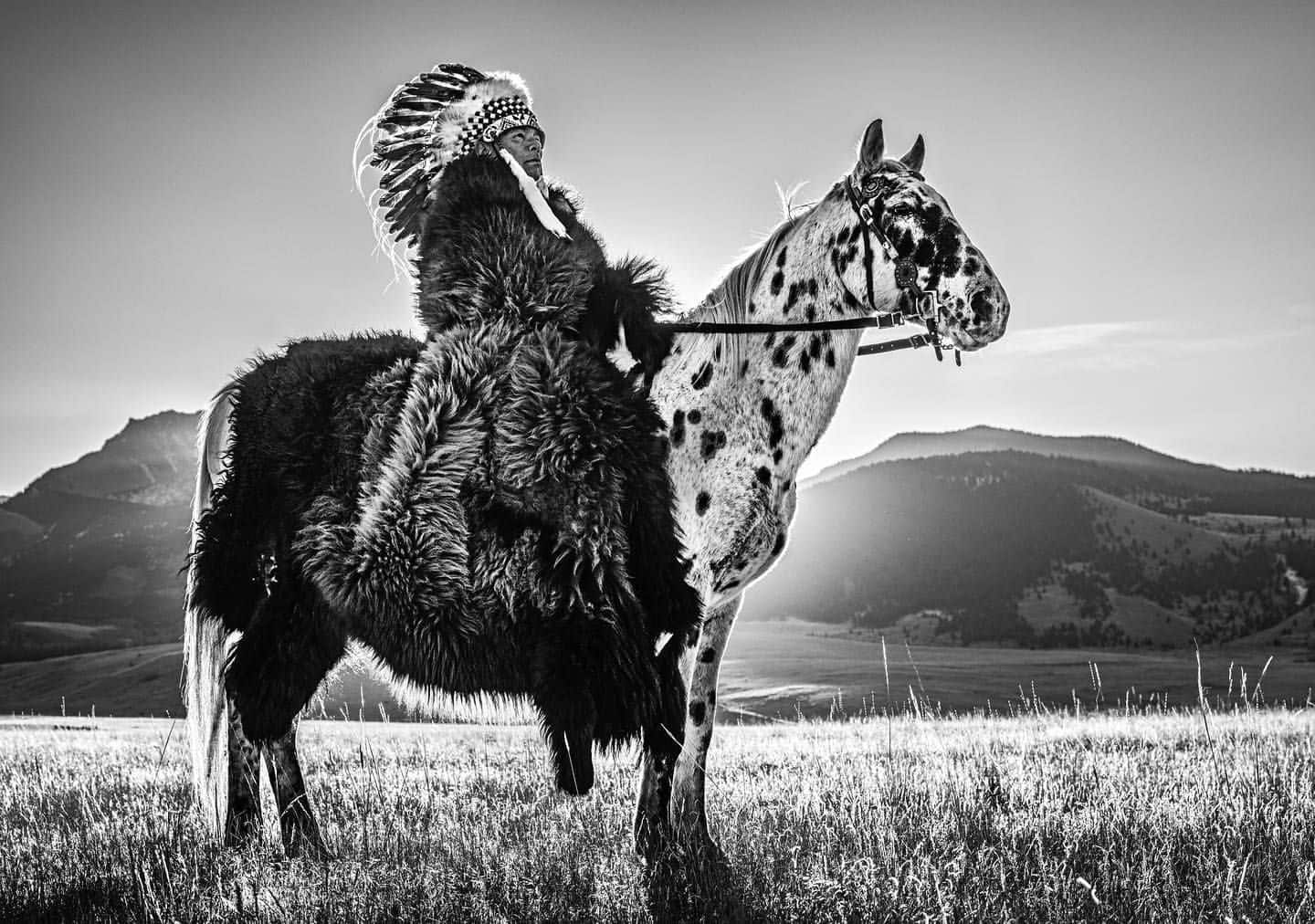
Lakota
Montana, USA 2020
My default position is always to glorify the subject – I am at heart a romanticist. Chief John Spotted Tail of the Lakota is not a hard subject to work with as much of the glorification is a given, bit we still needed the right horse, the right light and the right landscape.
We worked together initially in Wyoming, but I always wanted to photograph him in Montana too. The valley running south of Ennis to West Yellowstone offers stunning visuals and that was our focus. We determined the best light to be first thing in the morning and if we shot into the light looking east towards Big Sky, I knew we could have a strong frame.
Images shot directly against the light need a full tonal range and much of the credit for bringing out the shadow detail must go to my editing partners in Los Angeles. They and Chief John take the credit for this powerful photograph.
Available sizes
Large - Edition of 12
- Image Size: 56” x 80” in (142.24 cm x 203.2 cm)
- Framed Image: 71” x 95” in (180.34 cm x 241.3 cm)
Standard - Edition of 12
- Image Size: 37” x 53” in (93.98 cm x 134.62 cm)
- Framed Image: 52” x 68” in (132.08 cm x 172.72 cm)
We ship worldwide and use a multitude of providers to safely deliver your masterpiece. Domestic delivery and installation may also be available via Hilton Asmus Contemporary’s private art shuttle. Please inquire.
A River Runs Through It
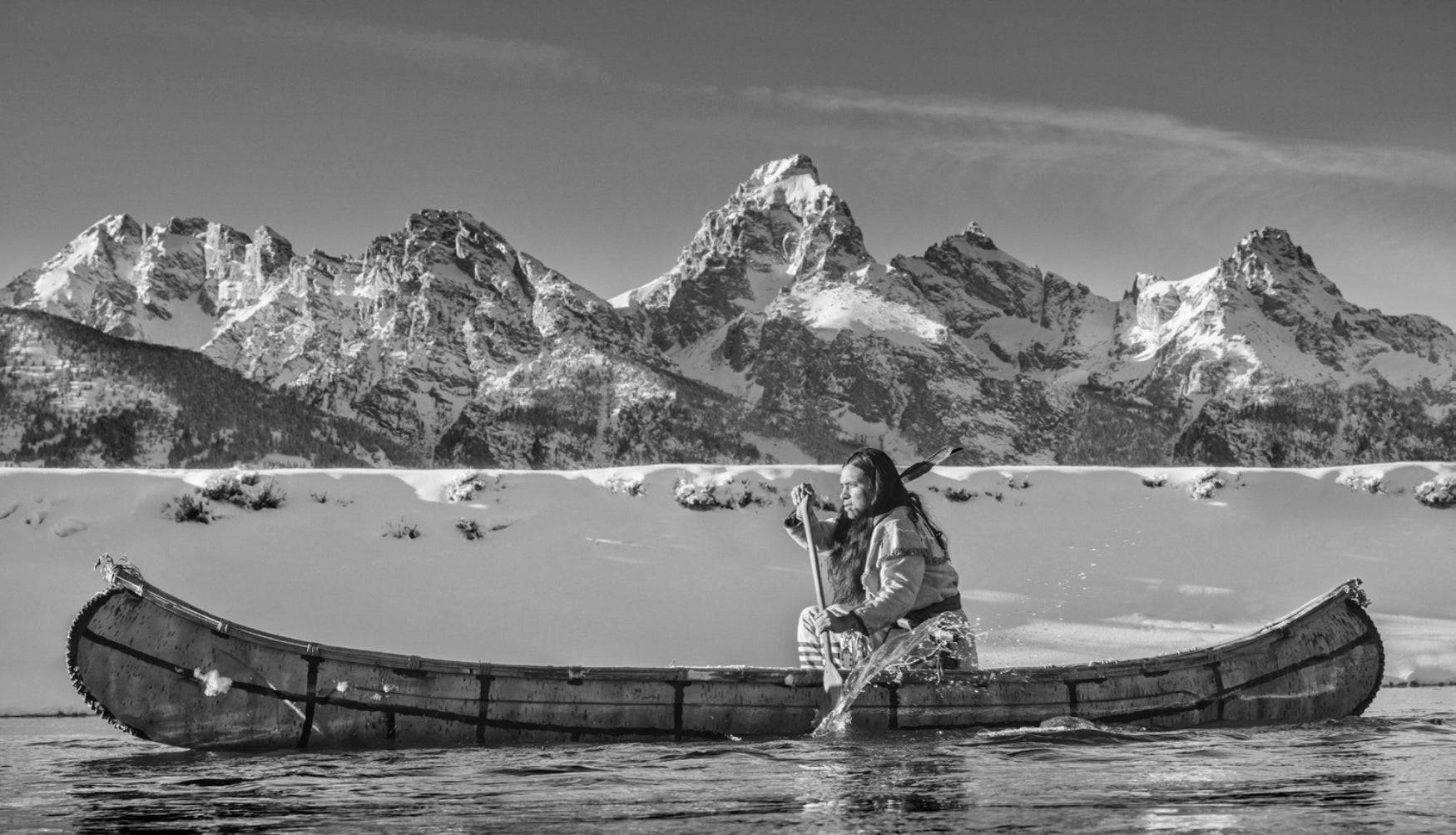
Grand Teton National Park, Wyoming, USA – 2021
Ansel Adams brought the majesty of Snake River and the Tetons into the homes of Americans in 1942. So there is no real commercial merit in a photographer travelling to this sensational destination in Wyoming and taking a loose landscape image on a tripod. They may take a beautiful image, but manifestly they would also be 79 years behind the curve. Teton National Park is an imperial amphitheatre deserving not only our attention, but also our respect, and we are rather late in the game in documenting its magnificence. New images of the Eiffel Tower rarely make a Sotheby’s auction.
My strategy in the Tetons was to play with what we had and be authentic in the additives. We threw around many ideas and then threw most Out. The most authentic suggestion was the idea of working with a native American in a 19th century canoe on Snake River itself. The concept was sound, but the execution was hampered by the fact that the most scenic stretches of the river are three miles further east from the mountains than I would like. On a standard lens, the peaks lose some of their sense of enormity. But there is one stretch of water where the river runs parallel and much closer to the mountain base. The river banks are a little higher and block the base, but this was a small price to pay for the improved proximity between the canoe and the mountain range.
In good light, this was always a late afternoon location, and the January temperature that day was low. I knew I was going to get wet and cold as the camera needed to be on the river’s surface and that meant me being deep in the river in normal ski clothing. The lower the camera, the more the mountains were amplified, and the canoe would also then be flat to my camera. The picture was all that mattered in those 10 minutes, not my comfort.
Haatepah in the canoe was so game and did an extraordinary job.
AVAILABLE SIZES:
Large: Edition of 12
- Image Size: 56” x 97” in (142.24 cm x 246.38 cm)
- Framed Image: 71” x 112” in (180.34 cm x 284.48 cm)
Standard: Edition of 12
- Image Size: 37” x 64” in (93.98 cm x 162.56 cm)
- Framed Image: 52” x 79” in (132.08 cm x 200.66 cm)
We ship worldwide and use a multitude of providers to safely deliver your masterpiece. Domestic delivery and installation may also be available via Hilton Asmus Contemporary’s private art shuttle. Please inquire.
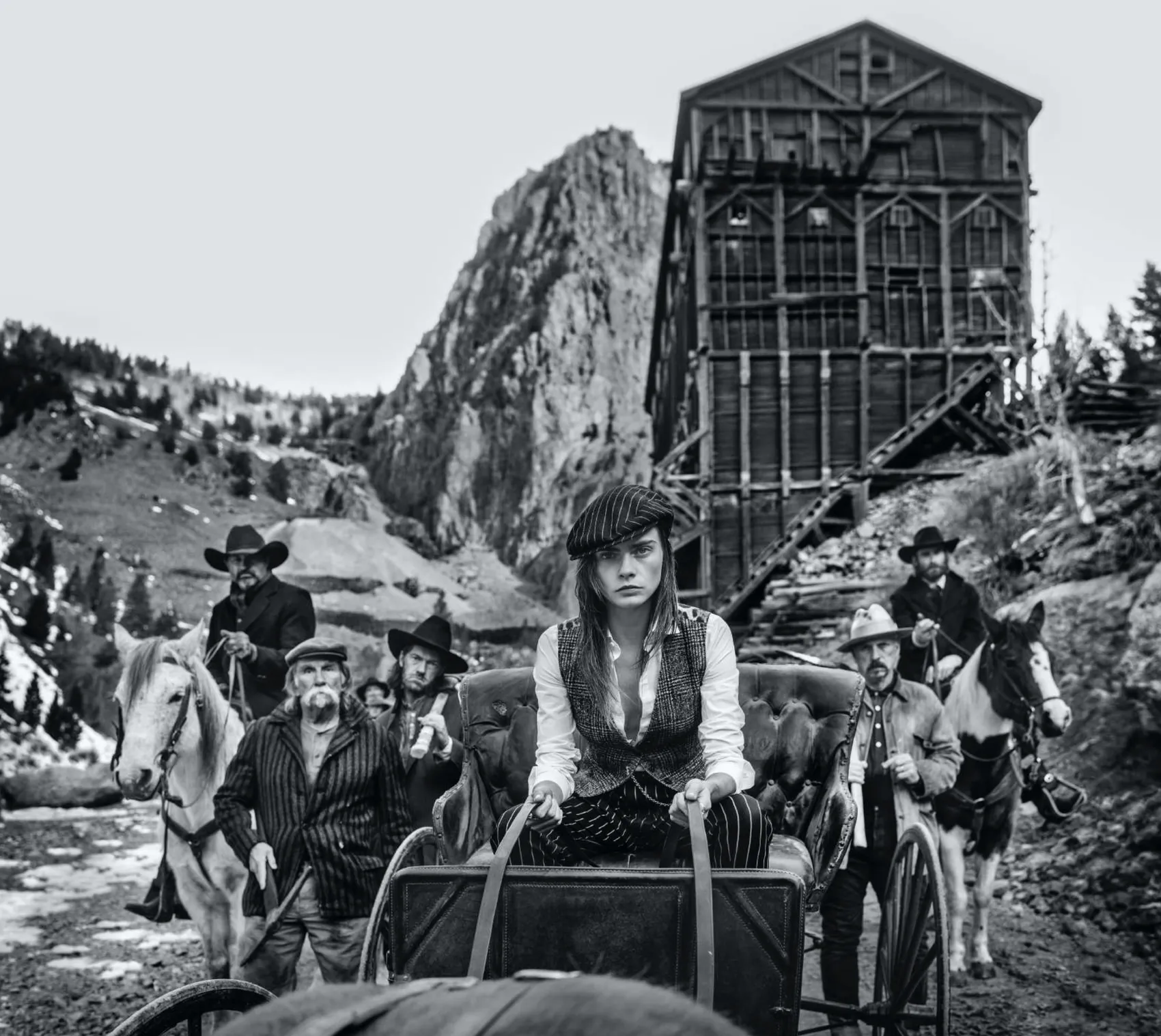
The Shift
AVAILABLE SIZES:
Standard
- Image size: 37" x 42"
- Framed with a 3" mat: 48" x 53"
- Framed with a 5" mat: 52" x 57"
Large
- Image size: 56" x 63"
- Framed with a 3" mat: 67" x 74"
- Framed with a 5" mat: 71" x 78”
We ship worldwide and use a multitude of providers to safely deliver your masterpiece. Domestic delivery and installation may also be available via Hilton Asmus Contemporary’s private art shuttle. Please inquire.
Bonnie
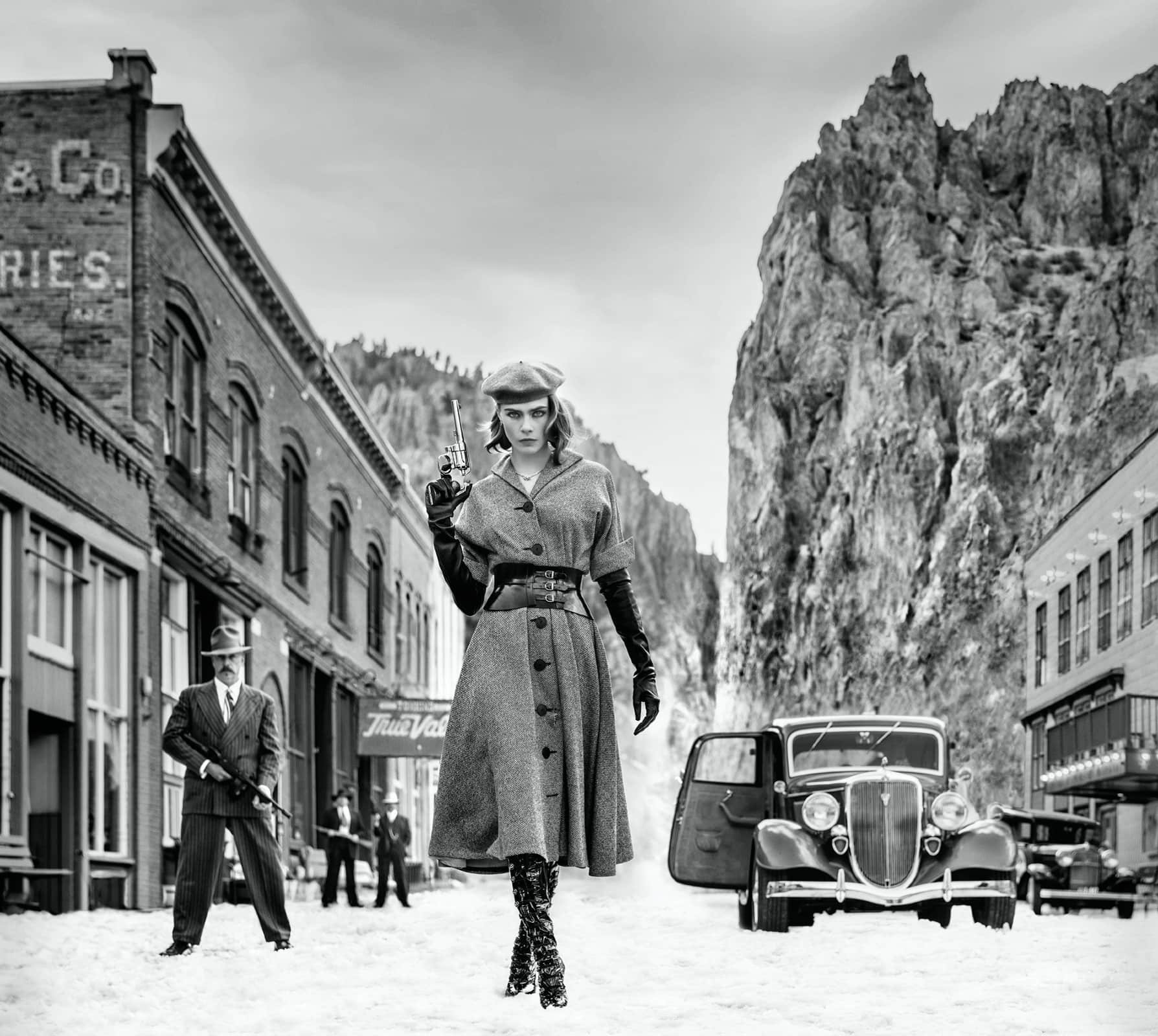
Creede, CO, USA 2021
The old mining village of Creede sits in a tight box canyon 9,000 feet up in the Southern Rockies of Colorado. An imposing vertical cliff face bullies main street and adds to the sense of ‘a town at the end of the line’. Creede plays to the lore and mythology of the wild west and consequently is awash with tourists during the summer. However, in the mid-winter, the place has an abandoned look to it and this was always going to be the best time to film. It would be a bridge too far to try to close the town down in July.
We had been throwing around ideas as to where to stage a Bonnie and Clyde story and chose Creede, not just because the high street is little changed from the 1920s, but because the locals, including the sheriff and the council, were fully supportive of our concept. To a man, the town folk of Creede were committed to helping us bring the project to fruition. For two days, our crew and extras seemingly doubled the winter population of Creede and the one restaurant in town was at capacity most of the time.
Fine tuning the composition was a challenge as ideally, I wanted Bonnie – played by Cara Delevingne – to be as big a part of the image as possible, but I also needed the buildings on both sides of the street to frame the narrative in the middle. Working with wide angle lenses risks making a loose image and I was determined not to fall into that trap. We had not dragged everyone up to this cold final frontier outpost to create a mundane image.
My goal was to create one single vignette to emphatically celebrate the heavily mythologised story of Bonnie and Clyde. It therefore had to be rich enough to inform, whilst remaining simple and cinematic. The final result is a great credit to all involved – Cara, her team, my production team and the many extras.
Faye Dunaway played Bonnie in the original film and she was my reference for Cara, who played the role immaculately, as I knew she would. Meanwhile, we will never know whether the driver in the car gave his best Warren Beatty impersonation – perhaps that’s just as well.
AVAILABLE SIZES:
Standard
- Image Size: 52" x 56"
- Framed with a 3" mat: 63" x 67"
- Framed with a 5" mat: 67" x 71"
Large
- Image size: 71" x 77"
- Framed with a 3" mat: 82" x 88"
- Framed with a 5" mat: 86" x 92”
We ship worldwide and use a multitude of providers to safely deliver your masterpiece. Domestic delivery and installation may also be available via Hilton Asmus Contemporary’s private art shuttle. Please inquire.
The Thundering Herd
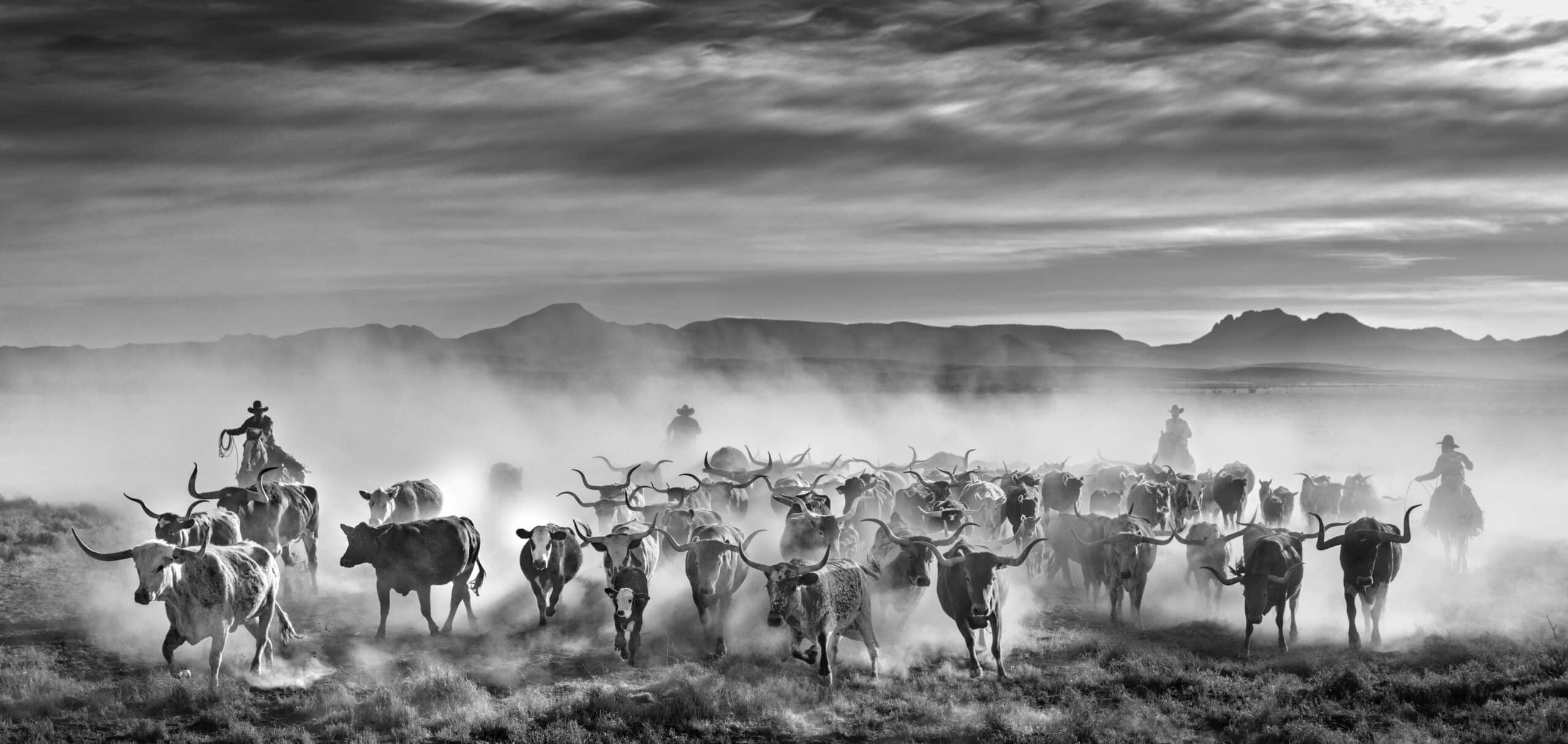
Texas, USA 2021
Looking back at my 38 years of holding a camera, there have been a few key moments along the way. Maradona in 1986 being my initial prompt. But it was probably way later in 2014 when I took the picture Mankind in a cattle camp near Yirol in South Sudan that my life changed. To borrow from Eddie Cantor “it took me 30 years to be an overnight success”. There have been many failures along the way.
I had recently considered returning to South Sudan to re-photograph that exact location, but a combination of COVID and an uptake in conflict in the country made that impractical. I also always have reservations on reshooting any previous set, it can hint at a lack of original thought.
Meanwhile, we had an idea. Our anthology to the “Wild West” – now in its six month of production – had allowed us to become familiar not just with the topography of much of the west, but with many cowboys and ranchers whom we now consider friends. The cowboy is integral to the enduring myth of the Wild West and no more so than in Texas, where the great cattle drives were first initiated. No state played a greater role in the trail drive era.
West Texas and South Sudan ostensibly don’t have much in common, but from a filming perspective there are some similarities. The land is flat and arid and in both locations the cattle are special. The horns of the cattle looked after by the Dinka in South Sudan, are magnificent, but the Texas Longhorn is no poor cousin.
With the help of two renowned Texan working cowboys – Craig Carter and Ryon Marshall – we spent last week filming near Valentine, not far from the Mexican border. I knew what I was looking for; a frame with depth; so as in South Sudan, I brought a ladder and a frame with contextuality and breadth; so, I knew that any lens with magnification would be a big error (it normally is anyway when a sense of place is integral to the creative vision).
I settled on a standard lens, but we had a problem, the dust being kicked up by the drives was intense. If the wind took the dust towards me, there was not just the inability to film, there was a danger of the thundering herd not seeing me. On one initial drive, they came out of the dust cloud just yards from my ladder. Not something I would recommend.
So, we worked out the formula, we would shoot against the light and with the herd directly downwind from me. As we rose at 4 am, we prayed the local weather forecast was accurate.
The cowboys, led by Ryon Marshall, were magnificent and after 72 hours we got the job done. The closing down party in the desert last Thursday night was something I will always remember. Great food, the most engaging company and, of course, country music. My team left with a warm glow and a real sense of connection with the cowboy culture down there. We can all learn something from it.
You gotta love Texas.
AVAILABLE SIZES:
Large: Edition of 12 + 3 AP
- Image size: 48" x 101" in (121.92 cm x 256.54 cm)
- Framed Image: 63" x 116" in (160.02 cm x 294.64 cm)
Standard: ALL EDITIONS ALLOCATED OR SOLD Please contact us for more information
- Image Size: 32” x 67” in (81.28 cm x 170.18 cm)
- Framed Image: 47” x 82” in (119.38 cm x 208.28 cm)
We ship worldwide and use a multitude of providers to safely deliver your masterpiece. Domestic delivery and installation may also be available via Hilton Asmus Contemporary’s private art shuttle. Please inquire.
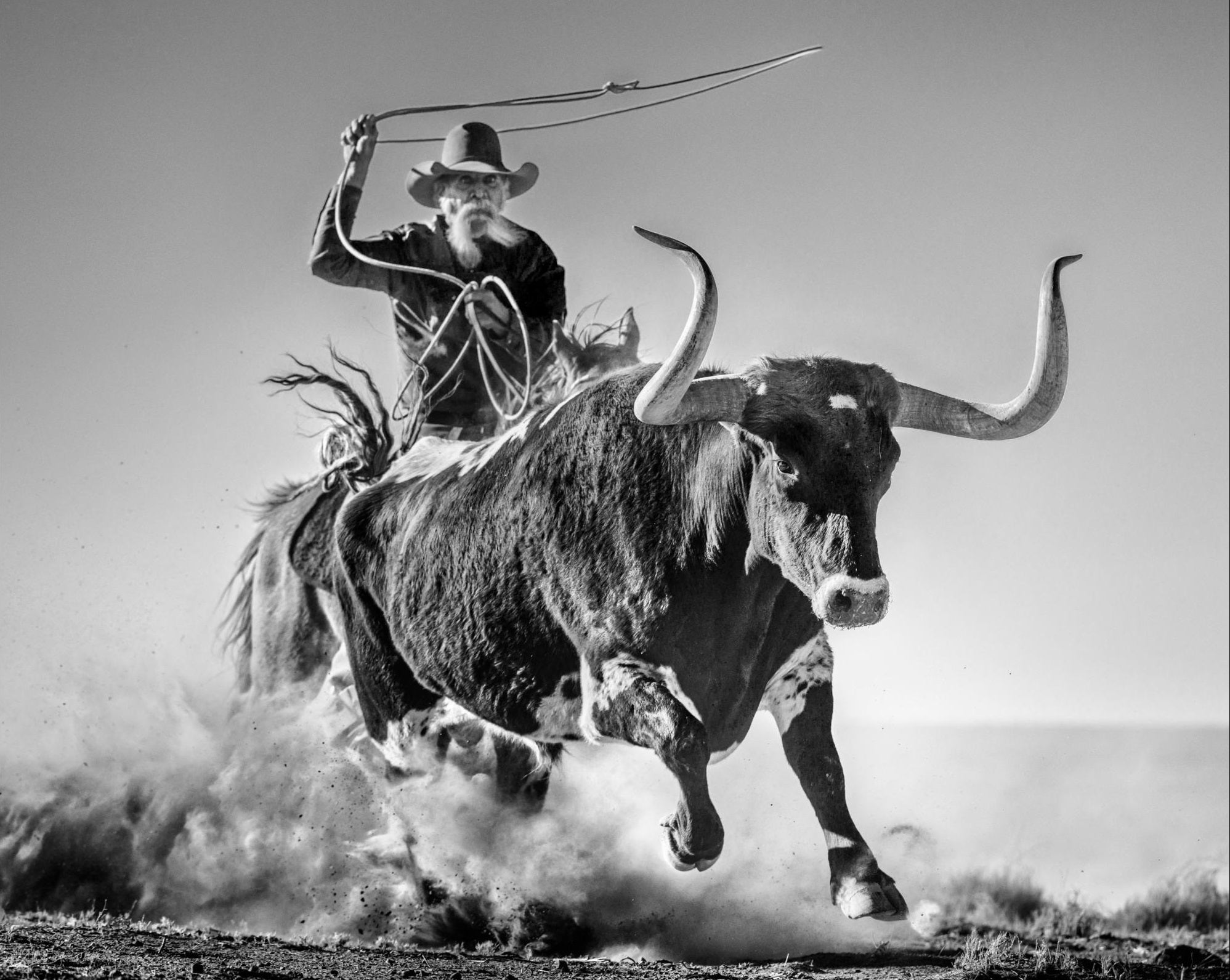
Ain’t My First Rodeo
Texas, USA 2021
The mythical cowboy, whose image has been shaped by history, fiction and folklore, is unquestionably America’s predominant symbolic native son. For many people across the world, a cowboy is the most American thing they can think of. For that we should be thankful. Much better this noun than a Big Mac or even an Apple Mac.
Texas is the home of the cowboy and it is also the home of the longhorn. It was the birthplace of the great cattle drives north to the Kansas railroads in the 1870s and the names of the State’s leading sports teams leave us in no doubt as to the pride in the region’s heritage.
The cowboy and the longhorn remain part of today’s Texas and in West Texas we have built up a strong network of contacts who are now happy to allow us to drop into their daily lives. Filmmaking in my mind is a team sport – we are always reliant on the help and excellence of others. We have invested time in the communities of western Texas and we are now slowly reaping the rewards.
This was not an easy frame to take, as the big steer is turning towards my default flat position on the ground. There is quite an adrenaline rush at that level of proximity and this is not something to try on your own. I had seasoned cowboys on the ground right beside me.
I had no expectation of Ryon Marshall – my go to Texan cowboy – being in pin sharp focus. It was not necessary for the narrative to hold up. What mattered was that the steer was flying and that the face and eyes were pin sharp.
The composition is fortunate, as it does look as if Ryon is flying. Anything is possible with him, as it certainly isn’t his first rodeo.
AVAILABLE SIZES:
LARGE: Edition of 12 + 3 AP
- Image Size: 56" x 70" in (142.24 cm x 177.8 cm)
- Framed Image: 71" x 85" in (180.34 cm x 215.9 cm)
STANDARD: Edition of 12 + 3 AP
- Image Size: 37" x 46" in (93.98 cm x 116.84 cm)
- Framed Image: 48" x 57" in (121.92 cm x 144.78 cm)
We ship worldwide and use a multitude of providers to safely deliver your masterpiece. Domestic delivery and installation may also be available via Hilton Asmus Contemporary’s private art shuttle. Please inquire.
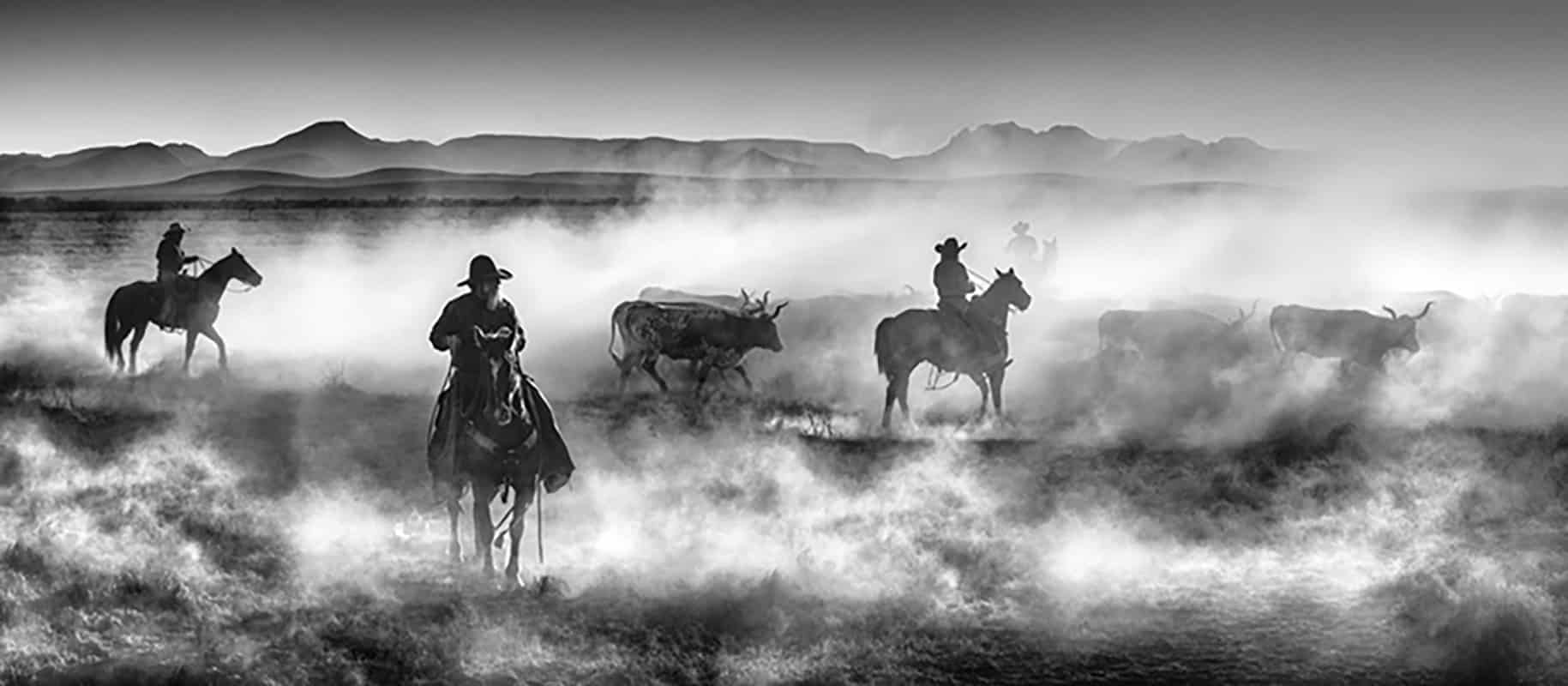
Drovers
This photograph was taken in 2021, but I sense it could have been taken in 1870. We are drawn to filming locations exuding a palpable sense of timelessness thus offering optionality on the narrative.
The more remote the location, the greater the possibility for us to remove the “now” and let our imagination jump into any era over the last six or seven generations. West Texas is my West World and that is why this bleak, mournful and unforgiving canvas has such a grip on me. It is part of America that time most certainly forgot. No wonder film makers have long been lured here.
Cowboys and cattle are not a new story; the partnership is one of the most enduring symbols of post-Civil War America and that is why they visually complement this landscape so effortlessly.
We knew what we wanted to do here, but working against the light with this amount of dust is a low percentage game. Dust can be a cameraman’s friend as it defies gravity, but there is a tipping point when it becomes his foe. On this frame, the lead drover is just out of the dust storm allowing for detail and the full benefit of the back light. The rest of this particular series was of no use at all. That is what we mean by a low percentage game.
I am in awe of the cowboys with whom we work in West Texas. They are the real deal and nothing is too much trouble for them. They have manners, work ethic and a sense of duty.
Texas is often mocked, but I think we can learn a great deal from cowboy culture.
AVAILABLE SIZES:
Standard
- Image size: 30" x 67"
- Framed with a 3" mat: 41" x 78"
- Framed with a 5" mat: 45" x 82"
Large
- Image size: 44" x 101"
- Framed with a 3" mat: 55" x 112"
- Framed with a 5" mat: 59" x 116"
We ship worldwide and use a multitude of providers to safely deliver your masterpiece. Domestic delivery and installation may also be available via Hilton Asmus Contemporary’s private art shuttle. Please inquire.